Procurement Guide · Quality Verification · Import Risk Management
How to Verify SPC Flooring Quality Before Placing a Container Order — 7 Tests Every Importer Should Request
By Ecoflors · April 2026 · 11 min read · B2B Importer Reference
The direct answer — what to request and what numbers to expect
Before placing a container order for SPC flooring, request these seven third-party test results: (1) Core density ≥1.95 g/cm³ (ISO 1183), (2) Dimensional stability ≤0.10% (EN ISO 23999), (3) Wear layer thickness — physical cross-section verification, (4) Peel resistance ≥50N/50mm (ISO 24345), (5) Click-lock strength ≥1,200N (ISO 24334), (6) Residual indentation ≤0.05mm (ISO 24343-1), (7) VOC certification — FloorScore, GREENGUARD Gold, or AgBB. All seven results should come from a named third-party laboratory — SGS, Intertek, TÜV, or BV — not from the factory’s own QC department. A factory that cannot provide all seven with verifiable certificate numbers represents a procurement risk that no price discount compensates for.
Why Factory Claims Alone Are Not Enough
Most SPC flooring failures experienced by importers are not product failures — they are procurement failures. The flooring that arrives in a container and causes problems on site was not verified before departure. The factory’s data sheet stated the correct numbers. The product that shipped did not match those numbers. Specifically, the gap between a factory’s stated specification and its actual production quality is where container-scale procurement losses originate.
The flooring industry has a well-documented problem with self-declared performance data. A data sheet costs nothing to produce and is not verified by any authority unless a third-party test report is attached. Consequently, the only reliable quality verification method is requesting test reports from independent, named third-party laboratories — and verifying that the certificate numbers on those reports correspond to actual registered certifications.

Ecoflors automated SPC cutting line · Changzhou facility · ISO 9001:2015 certified · Every batch traceable to production records
This guide gives you seven specific tests, the standards they reference, the numbers you should expect, and the red flags that indicate a quality problem. Furthermore, it explains how to independently verify certifications without relying on documents provided by the factory — which is the step most importers skip, and the step that matters most.
Test 1 — Core Density (ISO 1183)
Core density is the single most important SPC quality parameter — and the easiest to independently verify through third-party testing. It is the direct physical result of the calcium carbonate to PVC ratio used in production. The correct commercial-grade SPC core density is 1.95–2.05 g/cm³. This range is achieved only when the calcium-to-PVC ratio is approximately 3:1 — the engineering standard for dimensional stability and indentation resistance. Lower density indicates either a reduced calcium ratio, recycled PVC content, or both. Higher density above 2.10 g/cm³ indicates excessive calcium content, which produces a brittle core prone to cracking under thermal cycling.
Test Standard
ISO 1183
Plastics — density test
Correct Value
1.95–2.05 g/cm³
Commercial-grade SPC minimum
Test Lab
SGS / Intertek / TÜV
Third-party only — not factory QC
Red flag: Density below 1.85 g/cm³ — indicates low calcium ratio or recycled PVC. High thermal expansion and indentation risk.
Red flag: No ISO 1183 report — factory quotes density without test documentation. This is a self-declared figure with no independent verification.
What to request: Third-party ISO 1183 density report with the laboratory name, report date, and tested batch reference. Verify the lab name against the SGS or Intertek client portal if possible.
Test 2 — Dimensional Stability (EN ISO 23999)
Dimensional stability measures how much an SPC plank expands or contracts under thermal change. It is the parameter that determines whether a floor’s click joints remain tight or develop visible gaps after installation — particularly in UK homes with underfloor heating, Australian summer temperatures, and US climate zones with significant seasonal swing. The correct certified value is ≤0.10% per EN ISO 23999. Across a 1,000mm plank, this means a maximum dimensional change of 1mm — well within the tolerance of a correctly installed floating floor with appropriate expansion gaps. Some suppliers quote ≤0.05% on their data sheets. This figure is not a recognised EN ISO 23999 reporting threshold. Always request the actual third-party test report — not just the data sheet claim — to verify the real tested value.
Test Standard
EN ISO 23999
Also ASTM F2199 (US)
Correct Value
≤0.10%
EN ISO 23999 certified threshold
Test Temp
23°C reference
Confirm test conditions on report
Red flag: Data sheet quotes ≤0.05% without a test report. This is not an EN ISO 23999 reporting threshold — it is an unverifiable marketing claim.
Red flag: Tested value above 0.15% — the floor will show visible joint gapping within 12–24 months in any climate with seasonal temperature variation.
What to request: EN ISO 23999 test report from a named third-party laboratory showing the actual measured value, test date, and sample batch reference.
Test 3 — Wear Layer Thickness (Physical Verification)
The wear layer is the transparent PVC film that determines EN 685 utilisation class and commercial lifespan. It is also the easiest parameter for a factory to misrepresent — stating 0.5mm on a data sheet while shipping 0.3mm. The only reliable verification method is physical cross-section measurement on a sample plank, confirmed by an independent inspection company (SGS, Intertek, Bureau Veritas, or QIMA). The measurement must be taken from a cross-section cut of the actual plank — not from the factory’s production records. Wear layer thickness determines the product’s EN 685 utilisation class: 0.3mm achieves Class 31/33, 0.5mm achieves Class 33/42, 0.7mm achieves Class 43 (SPC click) or Class 44 (Dryback with adhesive bond).
Method
Cross-section cut
Physical measurement under microscope
Tolerance
±0.02mm max
Acceptable production variance
Who measures
Independent inspector
Not factory QC department
Red flag: Factory provides only a production specification sheet — no physical cross-section measurement by an independent inspector.
Red flag: Measured thickness is more than 0.05mm below the stated value — this is systematic under-specification, not production variance.
What to request: Pre-shipment inspection report from a named inspection company (SGS, Intertek, QIMA, or Bureau Veritas) including cross-section photographs and measured wear layer thickness values from multiple plank samples.
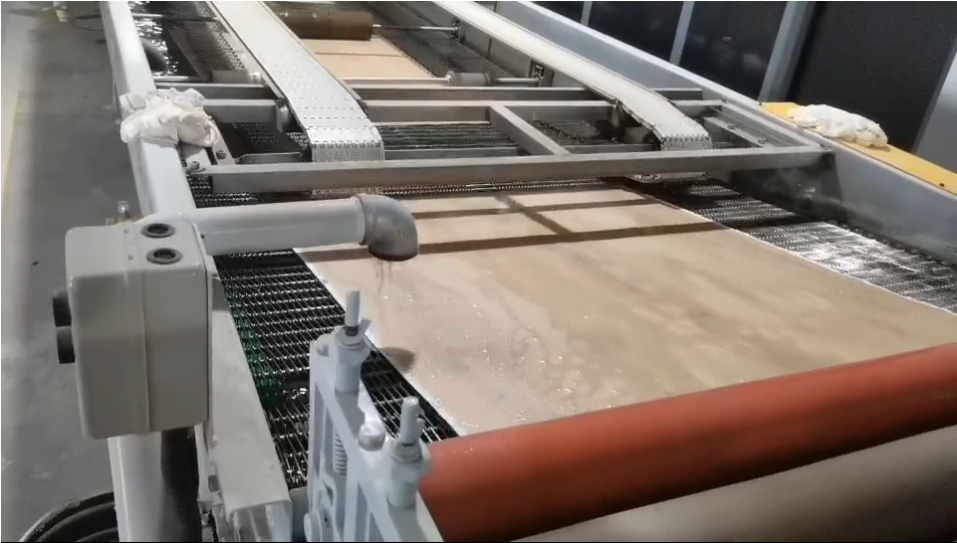
UV coating line — wear layer application and curing process · Ecoflors Changzhou production facility
Test 4 — Peel Resistance (ISO 24345)
Peel resistance measures the bond strength between the wear layer and the SPC core. Low peel resistance is the direct cause of wear layer delamination — the failure mode where the surface film separates from the plank body in service, producing visible bubbling, edge lifting, and surface peeling. The correct minimum value is ≥50N/50mm per ISO 24345. This test is particularly important for Dryback LVT in commercial environments where cleaning chemicals and steam mopping are routine — both of which accelerate delamination in products with insufficient wear layer bond strength. Furthermore, peel resistance is a warranty protection parameter for contractors and installers: a floor with insufficient peel resistance produces callbacks that exceed the floor value tenfold.
Test Standard
ISO 24345
Resilient floor coverings — peel test
Minimum Value
≥50N/50mm
Commercial-grade minimum
Applies To
All LVT + SPC
Critical for Dryback / wet areas
Red flag: No ISO 24345 peel resistance report. This is a fundamental LVT quality parameter — absence of testing is a significant quality signal.
Red flag: Results below 40N/50mm — delamination risk under sustained cleaning chemical exposure or steam mopping in commercial environments.
What to request: ISO 24345 peel resistance test report from a third-party laboratory, including the tested value in N/50mm and the sample batch reference.
Test 5 — Click-Lock Strength (ISO 24334)
Click-lock strength measures the force required to separate two joined planks — the direct indicator of whether the mechanical joint will maintain integrity under the lateral forces of rolling loads, thermal expansion, and foot traffic. The minimum acceptable value for commercial SPC is ≥1,200N per ISO 24334. This is particularly critical for herringbone and chevron pattern layouts, where the diagonal joint orientation concentrates lateral stress at joint edges. Specifically, a click system with strength below 800N will show progressive joint separation in high-traffic commercial environments within 12–24 months — producing the hollow-sounding, visibly gapped joints that generate warranty claims. The click system should also carry a licensed patent — Uniclic or Välinge 5G are the two primary licensed systems. Unlicensed profile copies have no quality control on joint tolerance.
Test Standard
ISO 24334
Click-lock tensile strength
Minimum Value
≥1,200N
Commercial applications
Click Systems
Uniclic / Välinge 5G
Licensed patents — verify
Red flag: Click profile is an unlicensed copy — no Uniclic or Välinge license documentation. No independent quality standard applies to the joint tolerance.
Red flag: ISO 24334 result below 800N — joint separation risk under commercial rolling load and thermal cycling.
What to request: ISO 24334 click-lock tensile strength report from a third-party laboratory, plus confirmation of the click system patent license (Uniclic or Välinge certificate number).
Test 6 — Residual Indentation (ISO 24343-1)
Residual indentation measures the permanent surface depression remaining after a concentrated load is applied and removed — the test that predicts whether the floor will show permanent dents from office chair castors, furniture legs, hospital trolley wheels, and retail shelving. The correct maximum value for commercial SPC is ≤0.05mm per ISO 24343-1. This test is often confused with dimensional stability — they measure different things. Dimensional stability measures thermal expansion of the whole plank; residual indentation measures localised surface deformation under point load. Both are required; one does not substitute for the other. For NHS hospital and airport specifications requiring EN 685 Class 44, residual indentation ≤0.05mm is a mandatory performance parameter alongside the permanent adhesive bond.
Test Standard
ISO 24343-1
Static indentation test
Maximum Value
≤0.05mm
Average across test points
Load Applied
500N / 1cm²
Simulates concentrated furniture load
Red flag: No ISO 24343-1 report. Often omitted because it reveals core density quality issues — absence of this test is informative in itself.
Red flag: Results above 0.10mm — visible and permanent denting under standard office and commercial furniture within months of installation.
What to request: ISO 24343-1 residual indentation report from a third-party laboratory, with the average measured indentation value and the number of test points used.
Test 7 — VOC Emissions (FloorScore / GREENGUARD Gold / AgBB)
VOC (Volatile Organic Compound) certification verifies that the flooring does not emit harmful chemicals at levels above the regulatory threshold for the destination market. Unlike the mechanical tests above, VOC certification is market-specific — the correct certification depends entirely on where the floor will be sold and installed. SPC flooring from 100% virgin PVC with no wood-based core components does not emit formaldehyde — the primary VOC concern with composite wood products. However, plasticizers, stabilizers, and adhesive residues can still produce VOC emissions in SPC, which is why third-party testing is required regardless of core material. The three market-specific certifications most relevant to Ecoflors’ target markets are FloorScore (US/AU), GREENGUARD Gold (US/global commercial), and AgBB (Germany/EU).
US / Australia
FloorScore®
SCS-FS-05154 · CDPH standard
Global Commercial
GREENGUARD Gold
UL 2818 · Schools + healthcare
Germany / EU
AgBB / Eurofins IAC
Leistungsverzeichnis required
Red flag: Certificate has no verifiable certificate number — or the number does not appear in the issuing body’s online database.
Red flag: Wrong certification for the destination market — FloorScore is not accepted as AgBB equivalent for German project specification, and vice versa.
What to request: The certificate itself with the certificate number, plus independent verification via the issuing body’s public database (scscertified.com for FloorScore, ul.com for GREENGUARD Gold).
How to Independently Verify Certifications — Without Relying on Factory Documents
The most important quality verification step is also the most frequently skipped: independently confirming that the certificates a factory provides actually exist and apply to the specific product you are purchasing. A certificate scan is easy to produce; a certificate that appears in a third-party database is not.
FloorScore® — SCS Global Services
scscertified.com → Products Directory
Search by company name or certificate number. Every genuine FloorScore® certificate is registered in this database. If the product does not appear, the certification is not valid for that specific product.
GREENGUARD Gold — UL
ul.com → GREENGUARD Certification
Search by brand or product name. GREENGUARD Gold certificates are product-specific — a company certificate does not mean a specific product is certified. Verify the specific product line.
CE Declaration of Performance
Contains Notified Body number (e.g., 0086 for BM Trada)
The CE DoP must contain the notified body number and the test report reference. Verify the notified body is accredited via the NANDO database (ec.europa.eu/growth/tools-databases/nando).
ISO 9001 — Manufacturer Quality System
Issuing body’s certificate register (SGS, Bureau Veritas, etc.)
ISO 9001 certifies the quality management system, not the product. It does not guarantee product performance — but its absence indicates the factory lacks a formal QC structure. Verify via the issuing certification body’s registry.

Ecoflors product range — all products verified against seven-point quality framework before export · Certificate numbers available on request
The Seven Red Flags That Indicate a Quality Problem
Seven red flags — any one of these warrants further investigation before placing an order
No third-party test reports — only factory data sheets. Self-declared performance figures have no independent verification and cannot be relied upon for project specification or customs compliance.
Dimensional stability quoted as ≤0.05% — not a recognised EN ISO 23999 threshold. Indicates either a misunderstanding of the standard or deliberate misrepresentation.
Core density below 1.85 g/cm³ — indicates recycled PVC content or insufficient calcium ratio. High thermal expansion and indentation risk.
Certificates without verifiable certificate numbers — cannot be confirmed in the issuing body’s database. Generic-looking certificates with no specific registration are frequently fabricated or shared across products.
Unlicensed click profile — no Uniclic or Välinge license documentation. No independent quality standard applies to joint tolerance, and the profile may infringe patents in the destination market.
Significant price below market average — commercial-grade SPC at prices more than 20% below market average almost always indicates compromises in raw material quality, wear layer thickness, or both. The cost savings at FOB are reliably exceeded by the cost of claims.
Refusal to allow pre-shipment inspection — a factory that declines independent pre-shipment inspection has a reason to do so. Any reputable manufacturer welcomes third-party inspection because it protects both parties.
Your Complete Pre-Order Verification Checklist
Use this checklist before confirming a purchase order. Each item corresponds to one of the seven tests above. A factory that can provide all seven — with verifiable certificate numbers — represents a low procurement risk. A factory that cannot provide three or more is a high-risk supplier regardless of price.
Pre-Container Order Quality Verification Checklist
ISO 1183 core density report — from SGS, Intertek, TÜV, or BV. Verify value is 1.95–2.05 g/cm³.
Ask for: “Please provide your ISO 1183 core density test report from a third-party laboratory.”
EN ISO 23999 dimensional stability report — tested value ≤0.10%. Not the data sheet claim — the actual test report.
Ask for: “Please provide your EN ISO 23999 dimensional stability test report with the actual tested value.”
Pre-shipment inspection with wear layer cross-section measurement — from an independent inspection company.
Ask for: “We will commission a pre-shipment inspection including cross-section wear layer measurement.”
ISO 24345 peel resistance report — ≥50N/50mm minimum.
Ask for: “Please provide your ISO 24345 peel resistance test report.”
ISO 24334 click-lock strength report — ≥1,200N minimum. Plus Uniclic or Välinge license confirmation.
Ask for: “Please provide your ISO 24334 click-lock tensile strength report and click system license documentation.”
ISO 24343-1 residual indentation report — ≤0.05mm average.
Ask for: “Please provide your ISO 24343-1 residual indentation test report.”
VOC certification for destination market — FloorScore (US/AU), GREENGUARD Gold (global), AgBB (DE/EU). Verify certificate number in issuing body database.
Ask for: “Please provide your FloorScore/GREENGUARD certificate number. We will verify in the SCS/UL database.”
What Ecoflors provides with every sample and shipment
Every Ecoflors sample kit includes the TDS with all seven parameter values plus the corresponding third-party test report references. Every container shipment includes the complete compliance document package — CE DoP with notified body number, FloorScore certificate SCS-FS-05154 (verifiable at scscertified.com), GREENGUARD Gold certificate, ISO 9001:2015 certificate, and all relevant market-specific compliance documents. Pre-shipment inspection by the buyer’s nominated inspector is welcomed at any stage of production.
Frequently Asked Questions
What tests should I request before ordering SPC flooring?
Request seven third-party test results: core density (ISO 1183, ≥1.95 g/cm³), dimensional stability (EN ISO 23999, ≤0.10%), wear layer cross-section measurement, peel resistance (ISO 24345, ≥50N/50mm), click-lock strength (ISO 24334, ≥1,200N), residual indentation (ISO 24343-1, ≤0.05mm), and VOC certification (FloorScore, GREENGUARD Gold, or AgBB for your destination market). All seven should come from named third-party laboratories — SGS, Intertek, TÜV, or Bureau Veritas.
How do I verify an SPC flooring factory’s certifications are genuine?
Verify directly through the issuing body’s public database. FloorScore certificates are searchable at scscertified.com. GREENGUARD Gold at ul.com. CE DoP notified body numbers via the EU NANDO database. ISO 9001 via the issuing certification body’s registry. If a certificate number does not appear in the issuing body’s database, it cannot be relied upon — regardless of how official the document looks.
What core density should SPC flooring have?
Commercial-grade SPC flooring should have a core density of 1.95–2.05 g/cm³, tested to ISO 1183. This is the direct physical result of the correct 3:1 calcium carbonate to PVC ratio. Density below 1.85 g/cm³ indicates either a lower calcium ratio or recycled PVC content — both of which reduce dimensional stability and indentation resistance.
Why do some factories quote ≤0.05% dimensional stability?
≤0.05% is not a recognised EN ISO 23999 reporting threshold. The correct certified value is ≤0.10%. Some suppliers quote ≤0.05% on data sheets as a marketing claim — always request the actual third-party test report to see the real tested value. If a supplier quotes ≤0.05% but cannot provide an EN ISO 23999 test report, the figure is unverifiable.
Can I commission a pre-shipment inspection myself?
Yes. SGS, Intertek, Bureau Veritas, and QIMA all offer pre-shipment inspection services in China — typically at a cost of US$200–400 per inspection. The inspector visits the factory, verifies quantities, checks carton labelling and packaging, and can include physical sample testing. A factory that declines to allow third-party inspection should be treated as a high-risk supplier.
Transparent quality verification · All 7 tests documented · Pre-shipment inspection welcomed
Request Our Complete Quality Documentation Package
Every Ecoflors sample includes TDS, CE DoP with notified body number, FloorScore certificate SCS-FS-05154 (verifiable at scscertified.com), GREENGUARD Gold certificate, and all seven test report references. Pre-shipment inspection by your nominated inspector is welcomed at any production stage. Dispatched within 5 business days.