Chevron LVP is a precision-mitered vinyl plank pattern where each plank end is cut at 45° or 60° — forming a continuous, unbroken V-shape along a central axis. This is structurally and visually distinct from Herringbone, which uses 90° square-cut ends. The perfection of a Chevron installation depends entirely on the angular cut tolerance at the mitered tip: we enforce a CNC cutting tolerance of <0.1mm on every plank end, because a 0.1mm deviation at the tip accumulates into a visible axis misalignment across a large commercial floor.
We produce both 45° (classic European proportion) and 60° (wide-format elongated aesthetic) Chevron. Both formats are packed as matched A/B mirror pairs — Left-hand and Right-hand planks in the same carton — so your installation team always has the correct mirror plank available without sorting on site. FOB pricing on request.
CNC precision engineering · The production standard that separates Chevron factories
Ecoflors · CNC Chevron Production Standard
The <0.1mm Standard. Why It Changes Everything.
Most vinyl plank factories produce straight planks. Chevron requires every plank end to be mitered at a precise angle — and the tolerance at that mitered tip determines whether the finished floor looks like precision parquet or an amateur cut job. We enforce a CNC cutting tolerance of <0.1mm on every plank end. This is not a marketing claim — it is the output specification on our profiling line QC report, available on request.
CNC Miter Tip Tolerance
< 0.1mm
Maximum deviation at the Chevron miter tip per plank. A 0.2mm deviation across 20 planks in a single V-run accumulates to a 4mm axis misalignment — visible from 3 metres. Our <0.1mm standard prevents this at the production stage.
45°
Classic Chevron
Traditional European proportion. Plank width-to-length ratio creates the classic V-point density preferred in hotel lobbies and boutique retail across DE, UK, and FR markets.
60°
Wide-Format Chevron
Elongated V-point for large open-plan spaces — corporate HQ reception, airport retail, and luxury residential with floor-to-ceiling volumes above 4m. The wider angle makes the space read as taller.
A/B Mirror Pair Packaging: Every carton ships with an equal number of Left-hand (A) and Right-hand (B) mirror planks. This means installers never run short of the required mirror profile mid-row — the single most common cause of Chevron installation delay on large commercial sites.
CNC production process — five-stage Chevron quality control
1
Core Compound Verification
Before the profiling line runs, we verify the SPC core density at 1.95–2.05 g/cm³ and dimensional stability at ≤0.10%. A core that does not meet this specification is rejected before the miter cut — because a dimensionally unstable core will cause the mitered tip to warp within weeks of installation, regardless of cut precision.
Core density 1.95–2.05 g/cm³ · EN ISO 23999
2
High-Speed CNC Profiling
The miter cut is performed by a dedicated CNC profiling spindle — not a general-purpose saw. The spindle geometry is set once per production run and verified every 500 planks against a calibrated template. The <0.1mm tolerance is measured at the tip of the miter, not the body of the plank.
<0.1mm tip tolerance · 500-plank QC interval
3
Painted Micro-Bevel Application
After the miter cut, we apply a painted micro-bevel to all four edges. On the mitered ends, this bevel serves two functions: it adds a shadow line that defines the V-shape visually, and it provides physical tolerance for the subfloor flatness requirement (≤2mm/2m) at the Chevron V-axis convergence point — where any lippage is immediately visible.
Painted bevel · 0.4–0.6mm · all four edges
4
A/B Mirror Profile Matching
Every plank is classified as A (left-hand miter) or B (right-hand miter) and paired automatically by the production line. We also verify that the A-board and B-board from the same production run form a gap-free V-joint before packaging — a physical fit test, not just dimensional inspection.
Physical fit test · A+B pair verified per run
5
Final SGS Inspection
SGS pre-shipment inspection covers dimensional conformity, colour match, click force, and packaging — with Chevron-specific verification of the miter tip geometry. The inspection report confirms <0.1mm tolerance compliance before the container is sealed.
SGS pre-shipment · miter geometry verified
Installation waste factor · The honest procurement calculation
Chevron Waste Factor — Our Honest Recommendation
12–15%
We recommend ordering 12–15% additional material above the measured floor area for any Chevron installation. This is a higher waste factor than Herringbone (8–10%), and we say so clearly — because the mitered plank tips generate triangular waste at every room perimeter, and the directionality of the V-pattern increases waste in non-rectangular rooms and around obstacles. On a 400 m² hotel lobby, this represents 48–60 m² of additional material versus the floor area measurement.
Why We Recommend the Higher Estimate
15%
For first-time Chevron installations, installer teams unfamiliar with mitered joints make more perimeter cuts than experienced parquet teams. Under-ordering by 3–5% on a 500 m² project means stopping production mid-floor to re-order — and new production batches never perfectly match the colour of the original run. We advise 15% for projects with complex room layouts or inexperienced installation teams, and 12% for experienced commercial flooring contractors.
Chevron vs Herringbone — Procurement Comparison
+5%
Chevron carries approximately 5% higher installation waste than Herringbone across equivalent room sizes. The CNC miter production process also means Chevron planks cost more per m² than equivalent Herringbone. If your procurement priority is lowest installed cost, Herringbone is the correct specification. If your priority is visual axis depth and spatial elongation, Chevron delivers what Herringbone cannot. Both statements are true simultaneously.
Technical matrix · Six parameters linked to Chevron-specific failure modes
Dimensional Stability · Miter tip integrity
≤ 0.10 %
The Chevron miter tip is the thinnest cross-section in the plank — typically 2–3mm of material at the point. A dimensionally unstable core causes this thin section to expand differentially, creating the “gaping tip” failure that exposes the core at the V-axis. We enforce ≤0.10% per EN ISO 23999 specifically because the miter tip has zero tolerance for differential thermal movement.
EN ISO 23999 · ASTM F2199
Chevron risk: Gaping or lifting at the V-tip under thermal cycling — most visible failure mode.
CNC Miter Tolerance
< 0.1 mm
Measured at the miter tip per plank, verified every 500 planks. In a 6-metre Chevron run of 20 planks per V-cycle, a 0.2mm deviation at each tip accumulates to 4mm of axis misalignment — visible from standing height at 3 metres. Our <0.1mm standard limits maximum accumulation to 2mm across a 6-metre run, below the visual detection threshold.
CNC in-line QC · calibrated template
Chevron risk: Axis misalignment is the defining quality indicator of a Chevron floor — visible immediately.
Painted Micro-Bevel · V-axis definition
0.4–0.6 mm
Painted micro-bevel on all four edges, including the mitered ends. The paint fills the bevel channel, creating a sharp colour contrast that defines the V-axis visually — the “French parquet” aesthetic that distinguishes Chevron from a flat-join pattern. This bevel also provides the physical tolerance buffer for the ≤2mm/2m subfloor flatness requirement at the V-convergence line.
All-four-edge painted bevel · 45° profile
Chevron risk: Without painted bevel, subfloor irregularities create visible lippage directly on the V-axis.
Peel Resistance
≥ 50 N/50mm
Mitered plank ends expose more wear layer edge area than square-cut ends. The 45° bevel creates a longer exposed edge cross-section at each plank tip. Our ≥50N/50mm peel resistance per ISO 24345 ensures this exposed edge remains bonded throughout the product lifetime under commercial foot traffic.
ISO 24345:2006
Chevron risk: Miter tip wear layer delamination at the V-axis convergence under pedestrian shear.
Residual Indentation
0.05 mm avg
In Chevron hotel lobby and boutique retail installations, point loads from display fixtures concentrate along the V-axis — the structural centre of the pattern. We verify 0.05mm average residual indentation per ISO 24343-1, confirming that sustained commercial furniture loads do not permanently deform the floor at the V-axis convergence zone.
ISO 24343-1
Chevron risk: V-axis indentation creates a visible track along the floor’s central visual reference line.
Fire Rating
Bfl-S1
Chevron is specified almost exclusively in high-end commercial environments — hotel lobbies, luxury retail, corporate reception — where Bfl-S1 (EN 13501-1) is mandatory under EU and UK building regulations. For Middle East projects (UAE, KSA), Bfl-S1 is also accepted as equivalent to Civil Defence fire rating standards without additional testing.
EN 13501-1
Commercial requirement: All EU/UK/UAE commercial Chevron installations mandate Bfl-S1 minimum.
Full specification table · Chevron SPC and LVT
Parameter
Value
Standard & Chevron Context
Cut Angle
45° or 60°
CNC profiling — 45° classic European proportion; 60° elongated for large-format spaces
CNC Miter Tolerance
< 0.1mm
Measured at tip per plank · verified every 500 planks against calibrated template
Dimensional Stability
≤ 0.10%
EN ISO 23999 — critical at mitered tip (thinnest cross-section) under thermal cycling
Peel Resistance
≥ 50N / 50mm
ISO 24345:2006 — mitered edge exposes longer wear layer cross-section than square cut
Residual Indentation
avg. 0.05mm
ISO 24343-1 — verified at V-axis convergence points under sustained commercial load
Painted Micro-Bevel
0.4–0.6mm · 45°
All four edges including miter — defines V-axis visually and masks subfloor tolerance
Fire Rating
Bfl-S1
EN 13501-1 — mandatory for all EU/UK/UAE commercial Chevron installations
Slip Resistance
R10 / DS
DIN 51130 — hotel lobby and luxury retail standard
Packaging
A/B Mirror Pair
Left-hand and right-hand planks packed together — eliminates on-site sorting delay
Installation Waste
12–15%
Higher than Herringbone (8–10%) due to mitered tip triangular waste at perimeters
Wear Layer
0.5 / 0.55 / 0.7mm
EN 660-2 Group T — 0.55mm EU commercial; 0.7mm for Class 42/43 heavy commercial
FOB Price
On request
FOB Ningbo or Shanghai — priced by angle (45°/60°), core and volume; quote within 24h
Application environments · Where Chevron delivers visual value that justifies the cost premium
Hotel Lobby · Corporate Reception · Boutique Retail
Our specification view
We recommend Chevron when
“We regard Chevron as the correct specification for high-end retail and boutique hospitality environments where the floor must communicate intentional design investment. Although the installation cost and material waste exceed Herringbone by 20–30%, the continuous V-axis creates a spatial elongation effect that no other floor pattern replicates. The floor becomes an architectural element, not a surface.”
Environments where Chevron delivers demonstrable ROI
Hotel Lobby & Corridor
The V-axis draws the eye towards the reception desk in hotel lobbies, and along the corridor length in guest room corridors. A 60° Chevron in corridors narrows the perceived width while extending the perceived length — a design tool used in luxury hospitality to make standard-width corridors feel more generously proportioned.
Luxury Retail & Showroom
Brand-conscious retailers use Chevron to signal design investment to customers — it communicates that the environment has been deliberately designed, not simply furnished. A 45° Chevron in a retail store entrance also creates a visual focal point that draws customers deeper into the space, supporting product display strategy.
Corporate Reception & Executive Floor
Chevron in corporate reception areas signals visual brand values without requiring any additional interior design. It is the most cost-effective way to upgrade a standard commercial fit-out to an environment that reads as architect-specified to visiting clients and senior candidates.
Concrete subfloor requirements · Chevron demands the tightest tolerance of any LVP pattern
≤ 3%
Moisture Content
CM method. Excess moisture causes the SPC core to hydrate at the mitered tip — the thinnest section — first. The tip lifts before any other part of the floor, creating a visible V-axis ridge within 3–6 months.
Chevron tip lifts first under moisture — no tolerance for non-compliance.
≤ 2mm
Flatness / 2m span
Maximum deviation across any 2-metre straight-edge. In Chevron, the V-axis runs continuously across the full floor length — any subfloor deviation is visible along the entire axis, not just at one point. The painted micro-bevel masks tolerance within ≤2mm; beyond it, lippage appears directly on the V-line.
V-axis lippage is the most visible subfloor defect in Chevron.
10mm
Perimeter Expansion Gap
All four sides without interruption. In 60° Chevron, the diagonal plank orientation creates a compound expansion vector — the floor expands both along and across the V-axis simultaneously. The perimeter gap must be maintained even at internal corners and door frames.
48h
Acclimatisation
Planks must reach installation environment temperature (18–28°C) for 48 hours before the A/B joints are engaged. For Middle East projects — UAE hotel lobbies with strong air-conditioning in summer — the transition from outdoor temperature to interior climate must be complete before installation begins.
Engineering note: Chevron is the most demanding LVP pattern for subfloor preparation. The continuous V-axis acts as a visual alignment reference that exposes every subfloor imperfection — unlike straight-lay or Herringbone, where imperfections are distributed and less obvious. We require written subfloor moisture and flatness inspection reports before authorising warranty on any commercial Chevron installation above 200 m².
Chevron vs Herringbone · Precision specification guide · Direct your project to the right pattern
This product
Chevron
45° or 60° mitered end · continuous V-axis · directional pattern
Chevron requires precision-mitered plank ends at 45° or 60°. When the A and B mirror planks meet, their tips form a continuous, unbroken V-axis across the full floor length. The visual effect is strongly directional — it draws the eye along the V-axis, elongating the perceived space. We recommend Chevron for environments where spatial elongation is a design objective and where the installation cost premium is justified by brand or hospitality value.
90° square-cut end · A/B interlocking · staggered zig-zag
Herringbone uses standard square-cut plank ends laid at 90° alternating angles. No mitered cuts required. Installation waste is only 8–10% — versus 15% for Chevron. The structural interlocking of the 90° A/B system provides stronger joint resistance under commercial loads. We recommend Herringbone for projects where procurement cost control and structural integrity are priorities, and where the visual objective is timeless texture rather than directional axis.
We advise on 45° versus 60° angle selection based on your room dimensions, ceiling height, and foot traffic direction. This is a specification service, not a sales call — the correct angle is determined by the room geometry, not by price.
Room geometry analysis included · 48h response
Exclusive Decor Development
We develop exclusive EIR wood grain patterns secured for your brand. In Chevron, the grain direction relative to the V-axis is a critical aesthetic decision — we advise on grain orientation before print film production begins.
We prepare a full TDS including CNC tolerance specification, subfloor requirements, A/B installation guide with diagram, and all certification documentation — issued in your brand name for architectural specification submissions.
CE · FloorScore · GREENGUARD Gold · SGS
Branded A/B Sample Kit
Physical samples of both A-board and B-board packed together, with your brand label and an A/B installation diagram card. This allows architects and contractors to physically verify the V-joint before specifying the pattern for a project.
5-day worldwide dispatch · A+B pair per sample
Related collections · Navigate by pattern or material
45° / 60° Chevron · CNC Precision · Factory Direct
Get Your Technical Data Sheet + FOB Price.
Send your angle specification (45° or 60°), core type, wear layer, target market, and project volume. You receive a FOB quotation, TDS with CNC tolerance documentation, and A/B sample dispatch confirmation within one business day.
Specify angle, core type, wear layer and market. We respond within one business day with FOB pricing, CNC tolerance documentation, and A/B sample dispatch confirmation.
ISO 9001
CE & FloorScore
24h TDS + Quote
<0.1mm CNC
Request physical samples & specs
1
SPC and LVT flooring, factory direct, FOB Shanghai. Send the construction, thickness, quantity and destination market and we'll come back with a matched specification and document list.

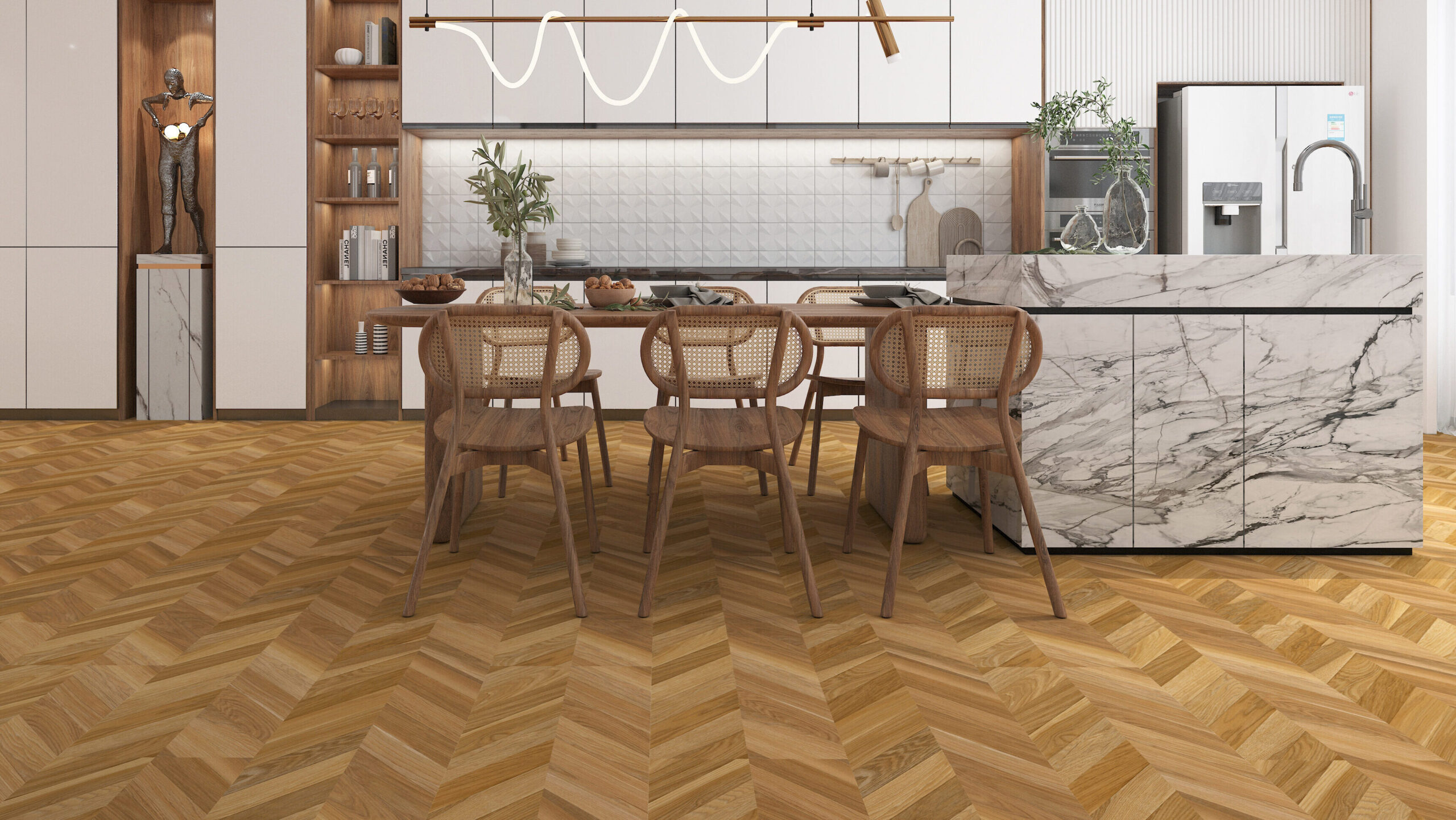
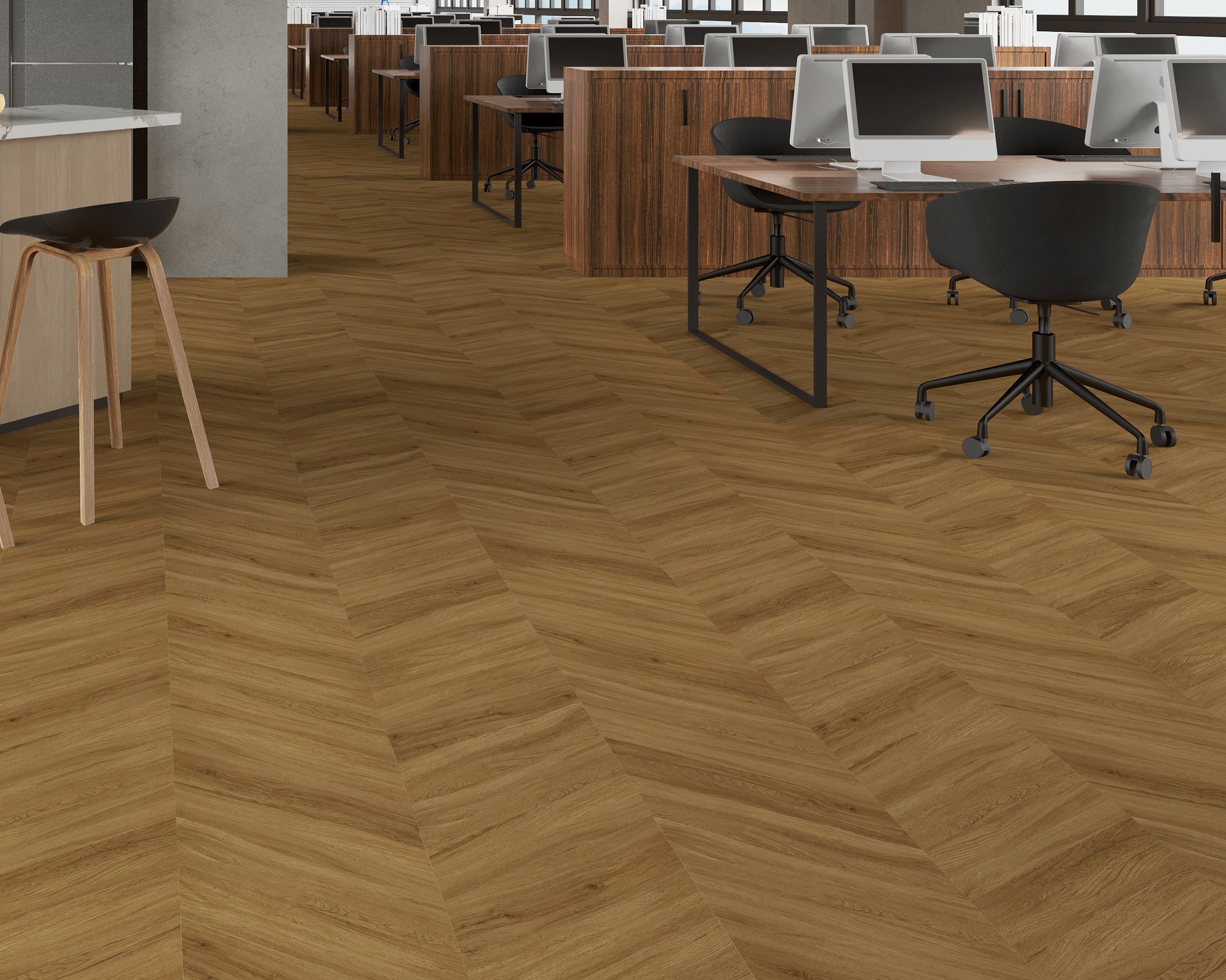 Hotel Lobby · Corporate Reception · Boutique Retail