5mm vs 6mm vs 7mm vs 8mm SPC Flooring: Which Thickness for Your Project? | Ecoflors
SPC Thickness GuideB2B ProcurementCommercial FlooringApril 202612 min read
5mm vs 6mm vs 7mm vs 8mm SPC Flooring: Which Thickness for Your Project?
Quick answer: SPC thickness is an engineering decision, not a quality decision. The correct thickness is determined by three factors: the EN 685 utilisation class required, your subfloor flatness tolerance, and the logistics budget per m². Specifically, 5mm (4mm core + 1mm IXPE) is the engineering optimum for hotel guest rooms, US multi-family residential, and light commercial. 7mm is the EU heavy commercial standard. 6mm bridges the gap when subfloor preparation is imperfect. 8mm is the maximum click SPC specification for the most demanding commercial environments.
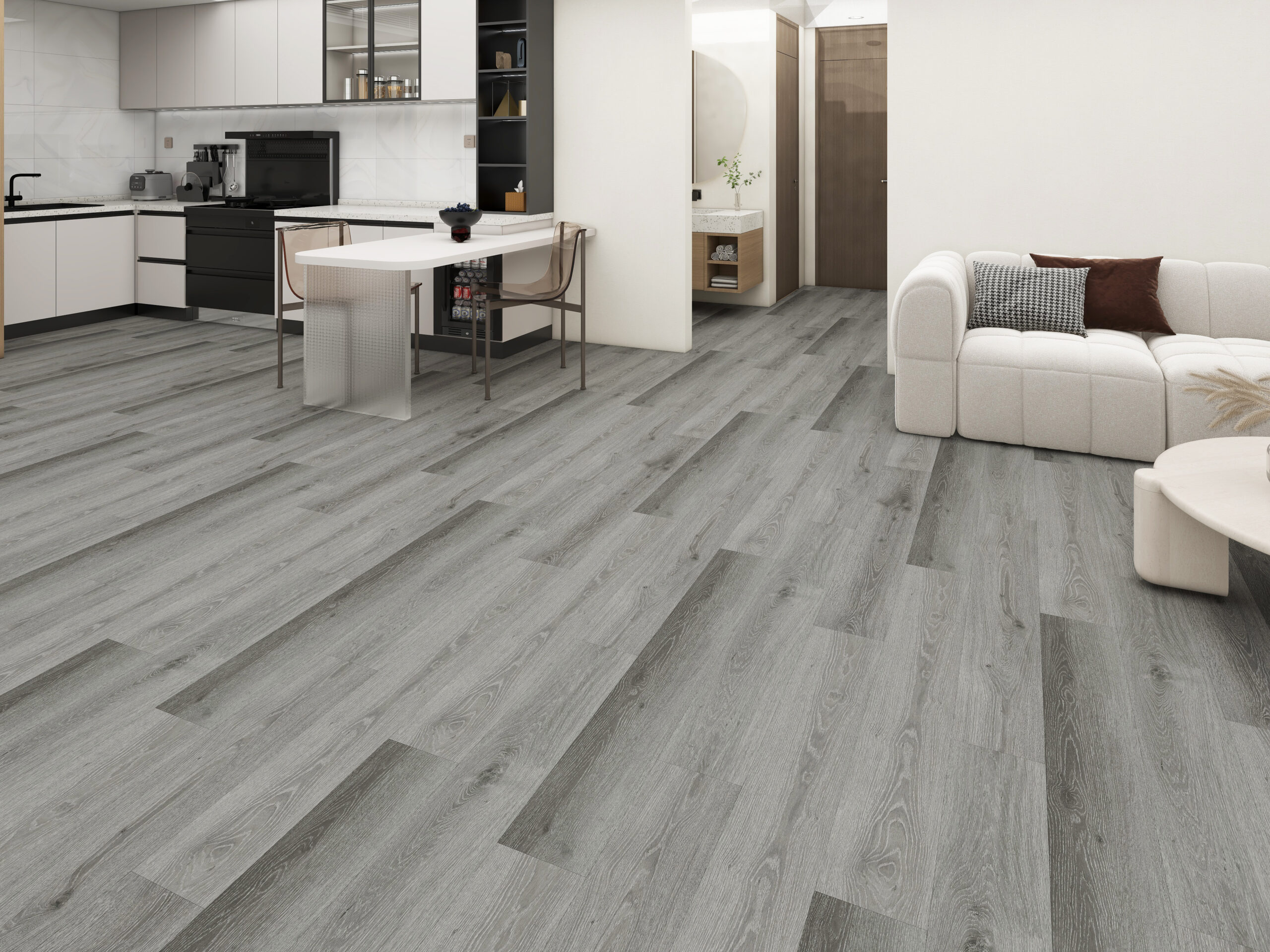
SPC click flooring in commercial installation — all thicknesses share the same 1.95–2.05 g/cm³ rigid core and ≤0.10% dimensional stability. Image: Ecoflors production facility, Changzhou.
Walk into any international flooring trade show and you will find every Chinese SPC manufacturer promoting “thick is better.” 8mm SPC is marketed as the commercial standard. 12mm is sold as the ultimate specification. The truth is considerably more nuanced — and considerably more useful for procurement decisions.
The reality is that all four common SPC thicknesses — 5mm, 6mm, 7mm, and 8mm — achieve the same dimensional stability (≤0.10%) when produced with the correct 1.95–2.05 g/cm³ limestone-PVC compound. Consequently, thickness above 5mm does not improve stability. It improves subfloor bridging, acoustic performance, and point-load resistance — three factors that matter in specific project environments, but not in all of them.
This guide gives you the engineering argument for each thickness, with real installation images, a side-by-side specification table, and a decision matrix you can use directly in project tendering.
Four SPC Thicknesses at a Glance
Before the engineering detail, here is a visual overview of all four specifications — with their key market position and FOB price entry point. Each card shows a real installation image of that thickness specification.
5mm SPC · Most Specified
5mm
4mm core + 1mm IXPE
US · UK · AU Standard
From US$6.35/m²
Hotel guest rooms, multi-family residential, light commercial. Lightest per container.
6mm SPC · Subfloor Bridge
6mm
5mm core + 1mm IXPE
EU Renovation
On request
Correct upgrade when subfloor flatness exceeds 2mm/2m. EU residential renovation standard.
7mm SPC · EU Commercial
7mm
6mm core + 1mm IXPE
NL · DE · Commercial
On request
EU heavy commercial standard. Class 42/43. Dutch and German social housing default specification.
8mm SPC · Max Rigid Core
8mm
7mm core + 1mm IXPE
ME · Heavy Commercial
On request
Maximum click SPC. Class 43. Middle East hospitality and high-footfall retail without Dryback.
The key insight before you read further
All four thicknesses achieve the same ≤0.10% dimensional stability — because stability is determined by the limestone-PVC compound ratio (1.95–2.05 g/cm³), not by core depth. Consequently, the decision between thicknesses is about subfloor bridging, acoustic performance, and point-load resistance — not about which product is “better quality.”
Understanding the SPC Layer Structure: What Changes with Thickness?
5-layer SPC construction · All thicknesses
Four layers stay constant. Only the core depth changes.
Across all four SPC thickness specifications, four layers remain identical: the UV coating (0.01–0.02mm), the wear layer (your choice of 0.3/0.5/0.7mm), the décor film (0.07mm EIR or Classical Wood), and the IXPE acoustic underlay (1mm pre-attached).
The only variable is the SPC rigid core depth: 4mm in 5mm SPC, 5mm in 6mm SPC, 6mm in 7mm SPC, and 7mm in 8mm SPC. Furthermore, the core compound — 1.95–2.05 g/cm³ limestone-PVC — is the same across all four specifications. Consequently, stability, fire rating, and chemical resistance are identical. Only bridging capacity, acoustic contribution, and weight change with thickness.
≤ 0.10%Dimensional stabilityAll four thicknesses · EN ISO 23999
Bfl-S1Fire ratingAll four thicknesses · EN 13501-1
≥ 50NPeel resistanceAll four thicknesses · ISO 24345
1mmIXPE pre-attachedAll four thicknesses · no separate purchase
5mm SPC (4mm Core + 1mm IXPE): The Engineering Case
5mm SPC in hotel guest room — the most common US and UK hospitality specification. 0.5mm wear layer, Välinge 5G click system, EIR oak grain.
5mm SPC · US · UK · AU primary market
4mm Core Reaches the Stability Threshold. Nothing More Is Needed.
The 4mm limestone-PVC core achieves ≤0.10% dimensional stability — the physical threshold at which thermal expansion stays within Uniclic joint tolerance across commercial temperature ranges. Specifying 6mm or 7mm with the same compound delivers identical stability — with higher weight, higher freight cost, and no performance improvement for hotel guest rooms or apartment buildings.
The logistics case for 5mm is equally compelling. At approximately 8–9 kg/m², 5mm SPC is the lightest specification in the click SPC range. A standard 20ft container approaches its 28-tonne weight limit before its volume limit with 7mm or 8mm SPC — meaning fewer square metres per container. Consequently, US West Coast and Australian importers shipping 5mm SPC receive 10–12% more floor coverage per container than the same shipment of 7mm, compounding the already lower FOB price advantage.
All 12 colour codes below are available on 5mm SPC — and on all other thicknesses from the same décor film batch, ensuring colour consistency across zones in the same project:
E88016L
Nordic Blonde
E88014L
Warm Linen Oak
E88001
Natural Sand
88282XL
Greige XL
88152L
Stone Grey
88102L
Cool Ash Grey
E89048L
Mid Warm Brown
E89044XL
Natural Timber XL
E88379XL
Harvest Amber
E88066L
Smoked Walnut
E88068L
Dark Espresso
E88213
Driftwood Taupe
6mm SPC (5mm Core + 1mm IXPE): The Subfloor Bridge
6mm SPC · EU renovation · Uneven subfloor
When 5mm Is Not Enough — and 7mm Is Too Much.
6mm SPC occupies a specific engineering niche: the correct specification when the subfloor flatness exceeds the ≤2mm/2m tolerance required by 5mm SPC, but the budget or door clearance does not permit 7mm. The additional 1mm of core depth increases the plank’s bridging capacity from ≤2mm to approximately 2–3mm of subfloor deviation — covering the tolerance gap in EU renovation projects where full subfloor preparation is not in the project scope.
6mm SPC EIR wood grain — EU renovation standard for projects with minor subfloor irregularities. Same ≤0.10% stability as 5mm and 7mm.
When to specify 6mm vs 5mm
If your project subfloor survey shows flatness deviation between 2mm and 3mm over a 2-metre straight-edge, and the project scope does not include full subfloor preparation, 6mm is the correct specification. If subfloor flatness is within ≤2mm/2m, 5mm is sufficient and delivers a lower logistics cost. Furthermore, if deviation exceeds 3mm/2m, no SPC thickness will bridge it — subfloor preparation is required before installation.
7mm SPC (6mm Core + 1mm IXPE): The EU Commercial Standard
7mm SPC in EU commercial environment — the standard specification for Dutch and German offices, retail, and social housing under EN 685 Class 42/43.
7mm SPC · EU heavy commercial · NL · DE standard
The Default EU Commercial Specification. Class 42/43.
7mm SPC with 6mm core is the de facto EU commercial standard for two reasons: it achieves EN 685 Class 42/43 for heavy commercial utilisation, and its greater mass provides superior resistance to sustained point loads from retail shelving, office furniture, and hospitality trolleys compared to 5mm or 6mm SPC. Moreover, Dutch Woningcorporaties and German social housing authorities specify 7mm as the default SPC grade for multi-family common areas and rental housing stock.
The Highest Rigid Core Available in Click Format. Class 43.
8mm SPC with a 7mm rigid core is the maximum click SPC specification — delivering the highest bridging capacity (up to 3mm/2m subfloor deviation), the greatest resistance to sustained point loads, and the best acoustic contribution in the click SPC category. Consequently, 8mm is specified for Middle East hospitality projects, high-footfall large-format retail, and commercial environments where the premium over 7mm is justified by the requirement to eliminate any risk of surface deformation under sustained load without switching to a bonded Dryback system.
8mm SPC EIR wood grain — maximum rigid core click SPC. Specified for Middle East hospitality and high-footfall commercial where 7mm budget is available.
Important: 8mm SPC still cannot achieve Class 44
Even at 8mm total thickness, click SPC cannot achieve EN 685 Class 44 — the floating joint generates micro-movement under sustained pallet jack and hospital trolley loads. Specifically, if your project requires Class 44, the correct product is 3mm Dryback LVT with permanent adhesive bonding — not thicker SPC. Class 44 is a bond-type requirement, not a thickness requirement.
Side-by-Side: All Four SPC Thicknesses Compared
Parameter
5mm SPC
6mm SPC
7mm SPC
8mm SPC
SPC Core Depth
4mm
5mm
6mm
7mm
Core Density
1.95–2.05 g/cm³
1.95–2.05 g/cm³
1.95–2.05 g/cm³
1.95–2.05 g/cm³
Dimensional Stability
≤ 0.10%
≤ 0.10%
≤ 0.10%
≤ 0.10%
IXPE Underlay
1mm pre-attached
1mm pre-attached
1mm pre-attached
1mm pre-attached
Impact Sound △IIC
21 dB
21–22 dB
22–23 dB
23–24 dB
Subfloor Tolerance
≤ 2mm / 2m
2–3mm / 2m
≤ 3mm / 2m
≤ 3mm / 2m
Max EN 685 Class
Class 33/42
Class 33/42
Class 42/43
Class 43
Fire Rating
Bfl-S1
Bfl-S1
Bfl-S1
Bfl-S1
Weight / m²
~8–9 kg
~9–10 kg
~10–11 kg
~11–12 kg
Container sqm (20ft)
Highest
High
Medium
Lowest
FOB Entry Price
US$6.35/m²
Request
Request
Request
Primary Market
US · UK · AU
EU renovation
NL · DE · EU
ME · Heavy commercial
Three Application Environments: Matching Thickness to Project Type
The best way to understand thickness selection is through real project environments. Below are three common scenarios with the thickness recommendation and the engineering reason behind it.
5mm SPC · US Multi-Family
Meets △IIC 21 and door clearance requirements. No undercutting. FOB from US$6.35/m².
7mm SPC · EU Commercial
Class 42/43. NL / DE default spec. Bridges minor subfloor irregularities in older EU building stock.
Logistics: 5mm vs 7mm
5mm delivers 10–12% more sqm per 20ft container — lower freight cost per m² for volume importers.
The Decision Matrix: Which Thickness Should You Specify?
Use this matrix to select the correct SPC thickness for your project. If none of these scenarios fits your requirements — specifically if you need Class 44 — the answer is Dryback LVT, not thicker SPC.
US hotel guest room or multi-family apartment — subfloor flat to ≤2mm
5mm delivers the same ≤0.10% stability as 7mm at lower weight and lower FOB. Fits standard US door clearances without undercutting. △IIC 21 meets most state IIC requirements without a separate underlay.
→ Specify 5mm SPC
EU renovation project — subfloor not fully prepared, 2–3mm deviation over 2m
6mm bridges the gap between 5mm’s ≤2mm requirement and 7mm’s full-preparation scenario. Consequently, it is the correct specification when grinding or screeding is not in the project scope but flatness is slightly outside 5mm tolerance.
→ Specify 6mm SPC
Dutch social housing, German office, or EU heavy commercial — Class 42/43 required
7mm is the default EU commercial specification — it achieves Class 42/43, satisfies Bfl-S1 requirements under Bouwbesluit 2012 and MBO, and is the standard grade for NL Woningcorporaties and DE commercial procurement.
→ Specify 7mm SPC
Middle East hospitality, large-format retail — maximum click SPC performance required
8mm delivers the highest bridging capacity and point-load resistance in the click SPC category. Furthermore, it provides the best acoustic contribution (△IIC 23–24) for multi-storey hospitality projects where sound transmission between floors is a design concern.
→ Specify 8mm SPC
Airport, hospital, or supermarket — Class 44 and sustained wheeled load
No click SPC achieves Class 44. Pallet jacks, hospital trolleys, and airport baggage carts require zero joint movement — which only permanent adhesive bonding delivers. Class 44 is a bond-type requirement, not a thickness requirement.
→ Specify 3mm Dryback LVT
Data centre or raised access floor — subfloor access required for maintenance
Neither SPC nor Dryback LVT is correct for raised access floors where individual planks must be lifted for cable access. Specifically, Loose Lay LVT with friction backing allows plank replacement in under 60 seconds without adhesive or click disassembly.
→ Specify 4–5mm Loose Lay LVT
Frequently Asked Questions
Q: Does thicker SPC mean better quality?
No. All four SPC thicknesses use the same 1.95–2.05 g/cm³ limestone-PVC compound and achieve the same ≤0.10% dimensional stability. Consequently, thickness above 5mm improves subfloor bridging, acoustic performance, and point-load resistance — not the core material quality. A 5mm SPC from a high-density compound outperforms an 8mm SPC from a low-density compound in every stability metric.
Q: Can I mix 5mm and 7mm SPC in the same project for different zones?
Yes, and this is a common procurement strategy for hotel and mixed-use projects. 5mm in guest rooms (cost-optimised, Class 31/33) and 7mm in public corridors and lobbies (Class 42/43, better acoustic performance). Furthermore, Ecoflors’ Universal Colour Matching produces both thicknesses from the same décor film print run — meaning the same colour code appears identical in both zones under equivalent lighting, eliminating the colour mismatch that occurs with mixed sourcing.
Q: What is the lead time and MOQ for SPC flooring from Ecoflors?
MOQ is 800 sqm per SKU (colour and specification combination) across all thicknesses. Production lead time is 15–25 days from order confirmation to FOB for standard colours. Custom OEM or exclusive colours take 25–35 days. All orders ship FOB Ningbo or Shanghai. Sample kits dispatch within 5 business days to US, EU, Canadian, and Australian addresses. HS Code: 3918.10.
Q: What certifications are included with every SPC shipment?
Every SPC shipment includes: CE Declaration of Performance (EN 14041), FloorScore certificate (SCS-FS-05154), GREENGUARD Gold documentation (UL 2818), CARB 2 compliance record, and SGS pre-shipment inspection report. For US projects, ASTM E648 Class I is available alongside Bfl-S1. For Canadian shipments, CBSA origin documentation is prepared before container sealing.
Q: Is 5mm SPC suitable for underfloor heating?
Yes. All four SPC thicknesses are compatible with both hydronic (water) and electric underfloor heating systems, rated to a maximum surface temperature of 27°C (EU standard) and 29°C (US standard). The ≤0.10% dimensional stability per EN ISO 23999 is certified across the full UFH temperature cycling range from −20°C to +60°C. Specifically, IXPE pre-attached underlay is the correct choice for UFH applications — EVA underlay retains heat differently and is not recommended directly over radiant systems.
Ready to specify your SPC thickness?
Get a FOB quotation, technical data sheet, and market compliance checklist within 24 hours. MOQ 800 sqm · FOB Ningbo or Shanghai.
Need vinyl flooring? We’re your OEM/customized LVT & SPC supplier with a super range of colors and patterns, great prices, and free samples – request yours now!