Herringbone vs Chevron Vinyl Plank: A Contractor’s Guide | Ecoflors

Herringbone vs Chevron Vinyl Plank:
A Contractor’s Guide to Pattern Selection

Quick answer: Herringbone uses rectangular planks cut at 90° and alternated A/B — producing a staggered zig-zag. Chevron uses planks with precision-mitered ends (45° or 60°) that meet at a continuous V-point apex. The visual difference is significant: Herringbone creates a broken zig-zag, Chevron creates a seamless, uninterrupted V-axis. The engineering difference is equally significant: Chevron requires CNC miter precision to ±0.05° and produces 12–15% installation waste versus Herringbone’s 8–10%. Both require ≤0.10% dimensional stability and a Uniclic or Välinge 5G click system — but Chevron demands tighter factory tolerances and higher installation skill to execute correctly.

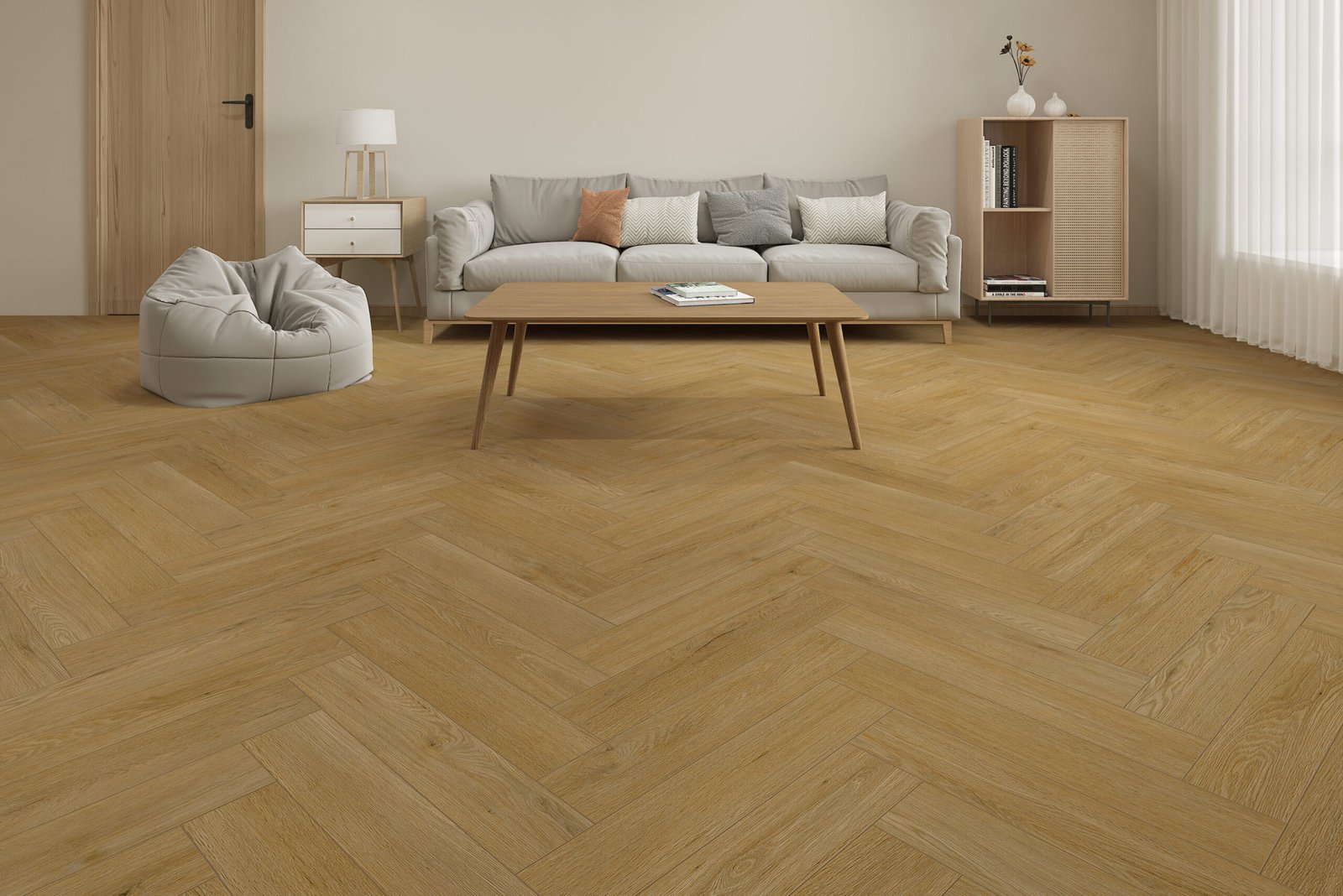
Herringbone LVP vinyl plank flooring installation — boutique hotel lobby — Ecoflors manufacturer
Herringbone vinyl plank in boutique hotel lobby — 90° alternating A/B plank layout. The staggered zig-zag creates visual interest while maintaining structural integrity through interlocking joint geometry. Image: Ecoflors Herringbone LVP collection.

Walk into any luxury hotel lobby, flagship retail store, or high-end residential development built in the last five years and you will almost certainly see either a herringbone or chevron floor. Both patterns have moved decisively from aspirational to mainstream — and both are now being specified in vinyl plank format rather than real wood, driven by the performance advantages of rigid-core SPC and LVT over solid hardwood in commercial environments.

For contractors, distributors, and procurement managers, the choice between herringbone and chevron is not simply a visual preference. It involves installation waste budgeting, factory cut-angle precision, click system selection, and the dimensional stability required to prevent apex misalignment over time. Consequently, this guide addresses the engineering decision, not just the aesthetics.


Side by Side: What Each Pattern Actually Looks Like

Herringbone vinyl plank flooring pattern — 90 degree alternating — Ecoflors
Herringbone · 人字拼 90° Square Cut

Rectangular planks alternated A/B at 90°. The joint lines create a staggered zig-zag — each plank end butts against the mid-point of the adjacent plank. Furthermore, the interlocking joint geometry distributes foot pressure across multiple planks simultaneously, creating structural integrity under sustained load.

Cut angle90° standard square
Install waste8–10%
Visual lineBroken zig-zag · staggered
Skill levelIntermediate
FOB fromUS$7.50/m²
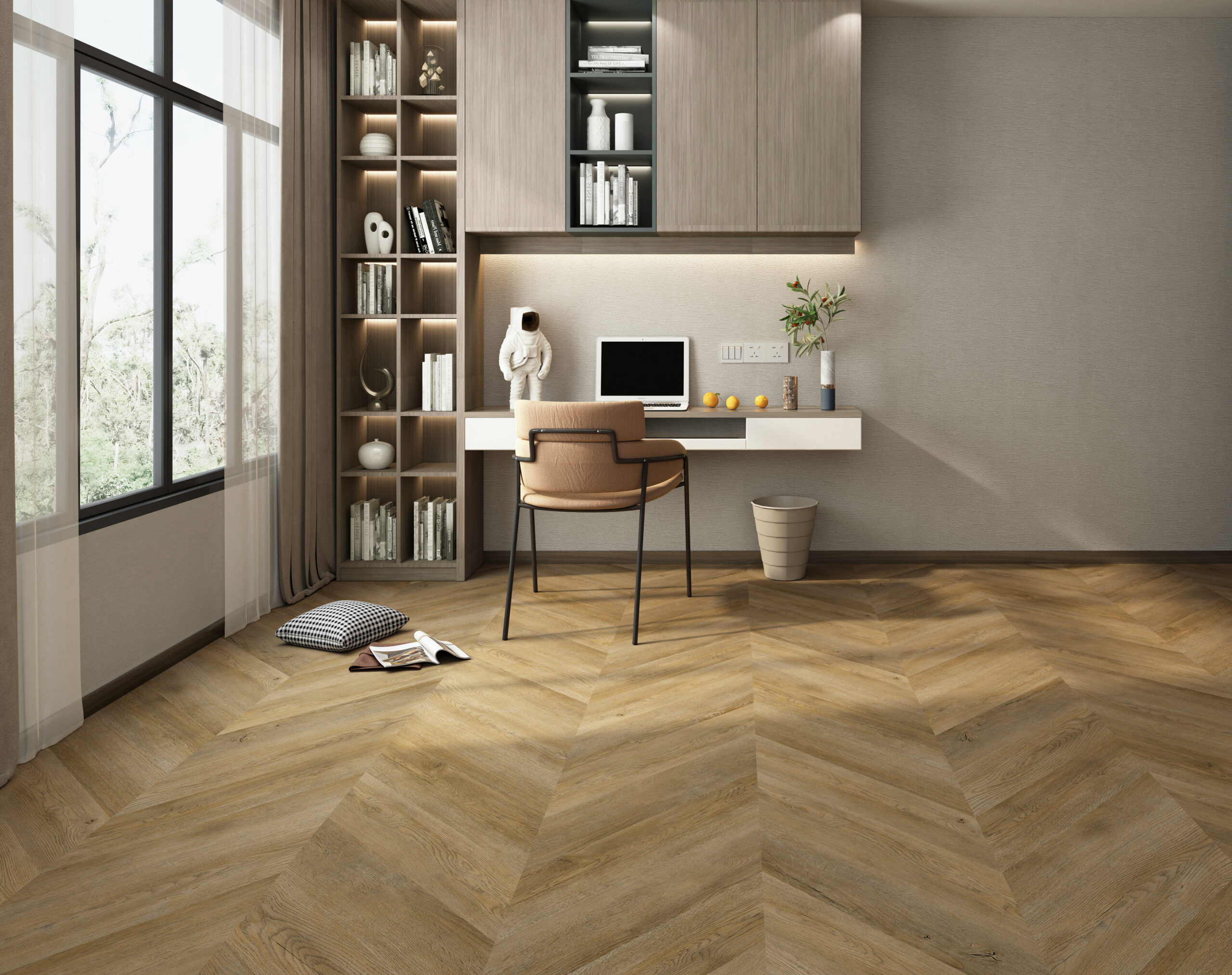
Chevron vinyl plank flooring pattern — 45 degree V apex — Ecoflors
Chevron · 雪佛龙 45°/60° Mitre Cut

Each plank end is precision-mitered at 45° or 60°. The mitered ends meet at a continuous V-point apex running the full width of the floor — creating an uninterrupted directional line that visually elongates the space. Specifically, the seamless V-axis is what distinguishes Chevron from Herringbone in any interior photograph.

Cut angle45° or 60° precision miter
Install waste12–15%
Visual lineContinuous V-axis · seamless
Skill levelAdvanced
FOB fromUS$8.20/m²

The Engineering Difference: Why Cut Angle Matters More Than It Looks

The visual distinction between herringbone and chevron is immediately obvious. The engineering distinction — the one that determines installation success or failure — is less visible but far more consequential.

Herringbone: The 90° Advantage

Herringbone EIR vinyl plank — 90 degree square cut — Ecoflors pattern flooring
Herringbone EIR vinyl plank — 90° square cut end. Standard rectangular plank used A/B alternating. No special factory miter required.
Herringbone · 90° square cut
Standard Rectangular Planks.
No Special Factory Cut Required.

Herringbone uses standard rectangular planks — the same dimensions as a straight-lay floor. The pattern is created entirely by the installer’s layout, alternating A-planks and B-planks at 90° to each other. Consequently, the factory’s only precision requirement is squareness tolerance — the plank ends must be cut to 90° within ≤0.15mm (ISO 24342).

This is a standard manufacturing tolerance that all competent SPC factories achieve. Moreover, because each plank end butts against the mid-length of an adjacent plank rather than aligning end-to-end, minor squareness variation is absorbed by the interlocking geometry — it does not accumulate across the floor as a visible misalignment.

Furthermore, the interlocking A/B geometry distributes concentrated foot pressure across multiple planks simultaneously — giving herringbone superior structural performance under point loads compared to straight-lay installation of the same plank.

Chevron: The 45°/60° Precision Requirement

Chevron · 45° or 60° CNC miter
Every Plank End Must Be Mitered.
Error Accumulates Across the Entire Floor.

Chevron requires every plank end to be precision-mitered at 45° or 60° using CNC equipment. The mitered ends of adjacent A and B planks meet at the V-axis apex — and this meeting point is visible across the entire floor width. Specifically, if the miter angle deviates by more than ±0.05°, the apex gap opens or overlaps — and this error compounds with every subsequent row, becoming visually obvious by the time 8–10 rows are installed.

On a 1.2m plank with a 45° miter, an angle deviation of just 0.1° produces a tip-to-tip gap of approximately 2mm at the apex. Across a 6-metre floor width (5 rows), this gap compounds to over 10mm — a visually catastrophic misalignment in any luxury interior environment.

Consequently, Chevron is not simply a more expensive version of Herringbone — it is a fundamentally different factory precision requirement. Not all factories that produce Herringbone can produce Chevron to the standard required for luxury hospitality and retail.

Chevron SPC vinyl plank — 45 degree CNC miter cut — Ecoflors pattern flooring
Chevron vinyl plank — 45° CNC precision miter. A/B mirror-pair planks. V-gap at apex held to ≤0.05mm across full floor width by ±0.05° cut tolerance.

Pattern Geometry: Visualising the Cut Angle Difference

Herringbone · 90° Alternating A/B
90° Square · A/B Alternating
Rectangular planks — same as straight lay. Pattern created by installer layout, not factory cut. Squareness tolerance ≤0.15mm sufficient.
Chevron · 45° Precision Miter A/B
V-axis 45° Miter · Continuous V-apex
Each plank end precision-mitered at 45°. V-apex runs continuously across full floor width. CNC tolerance ±0.05° required — error compounds with every row.

Cut Angle Options and Precision Standards

Herringbone · Factory precision required
≤ 0.15mm
Squareness tolerance per ISO 24342. This is the standard factory measurement for SPC plank ends — not a special precision requirement. Any competent SPC manufacturer achieves this as a baseline quality metric. Consequently, herringbone does not require a specialised cutting facility.
Chevron · Factory precision required
±0.05°
CNC miter angle tolerance. At 45°, this translates to a tip gap tolerance of <0.1mm at the apex. This requires dedicated CNC miter equipment, not standard SPC production lines. Ecoflors holds this tolerance across both 45° and 60° Chevron angles — verified by third-party measurement before container loading.

Chevron is available in two miter angles — each producing a different visual weight and directional emphasis:

Angle Visual Effect Best Application 45° ChevronModerate V-angle · balanced directional emphasis · most common specificationHotel lobbies · boutique retail · open-plan office 60° ChevronSteeper V-angle · stronger directional pull · visually more dynamic · less commonLong corridors · galleries · spaces where elongation is the design objective

Installation Waste and Total Project Cost

Installation waste is the percentage of flooring material cut and discarded during installation. For pattern flooring, waste is a significant procurement variable — particularly on large commercial projects where a 5% difference in waste can represent hundreds of square metres of additional material.

8–10% Herringbone waste Standard rooms · right-angle walls
12–15% Chevron waste Mitered ends · apex alignment cuts
US$7.50 Herringbone FOB from Per m² · FOB Ningbo
US$8.20 Chevron FOB from 45° · Per m² · FOB Ningbo
Parameter Herringbone Chevron 45°
Installation waste8–10%12–15%
Material to order (100m²)108–110 m²112–115 m²
FOB price per m²From US$7.50From US$8.20 (45°) / US$8.80 (60°)
Factory cut requirement90° square (standard)45°/60° CNC miter (specialist)
Installation skill levelIntermediateAdvanced — apex alignment critical
Click systemUniclic · Välinge 2G/5GVälinge 5G recommended
Dimensional stability req.≤ 0.10%≤ 0.10% — more critical at apex
Squareness tolerance≤ 0.15mm (ISO 24342)±0.05° CNC miter
Best visual effectStaggered zig-zag · classicSeamless V-axis · architectural
Procurement note on waste allowance

For Chevron on a 500 m² hotel lobby project, the difference between Herringbone’s 8% waste and Chevron’s 15% waste is approximately 35 m² of additional material. At US$8.20/m² FOB, this represents approximately US$287 additional material cost before freight — plus the higher installed price for specialist installation labour. Consequently, Chevron’s total procurement cost is typically 20–30% higher than Herringbone for the same floor area.


Why ≤0.10% Dimensional Stability Is More Critical in Pattern Layouts

EIR embossed vinyl plank pattern flooring texture — Ecoflors SPC LVT
EIR ±0.1mm registered texture — available on all Herringbone and Chevron specifications. The embossed grain aligns with the printed decor across the full plank length.
Dimensional stability · Why it matters more in pattern layouts
Small Planks. Multiple Joints. Higher Cumulative Risk.

Herringbone and Chevron patterns use shorter planks — typically 12″×24″ or 6″×36″ — compared to the 9″×72″ planks common in straight-lay SPC. Specifically, more joints per square metre means more potential accumulation points for thermal expansion. Additionally, in a Chevron pattern, thermal expansion occurs simultaneously in two directions — along the V-axis and perpendicular to it — rather than just along the length of the plank.

This is why ≤0.10% dimensional stability per EN ISO 23999 is not simply a desirable specification for pattern flooring — it is the mandatory threshold below which apex gaps and joint lifting become visible over one heating season. Furthermore, this stability figure must be achieved by the core compound, not by ambient temperature control — a floor that behaves correctly at 20°C but expands at 30°C under summer UFH does not qualify.

All Ecoflors Herringbone and Chevron products achieve ≤0.10% across the full temperature range from −20°C to +60°C, certified to EN ISO 23999 and ASTM F2199.


Where Each Pattern Is Specified: Real Application Environments


Available Colours: EIR Wood Grain Collection

All colours below are available in both Herringbone and Chevron format — on SPC rigid core and LVT platforms. The EIR ±0.1mm registration ensures the embossed wood grain aligns with the printed décor across every plank in the pattern, maintaining visual continuity at every joint.

EIR 6096-7
6096-7
Deep Smoked Walnut
EIR ±0.1mm
EIR 33004-002
33004-002
Nordic Linen White
EIR ±0.1mm
EIR 33004-005
33004-005
Natural Linen Beige
EIR ±0.1mm
EIR 33004-007
33004-007
Stone Mid Grey
EIR ±0.1mm
EIR CDW4105EL-17
CDW4105EL-17
Natural Honey Birch
EIR ±0.1mm
EIR CDW4105EL-18
CDW4105EL-18
Warm French Oak
EIR ±0.1mm
EIR HL6069-2
HL6069-2
Nordic Light Oak
EIR ±0.1mm
EIR HL6096-1
HL6096-1
Mid-Tone Natural Brown
EIR ±0.1mm
EIR KBW1103-12
KBW1103-12
Pearl Linen
EIR ±0.1mm
EIR KBW-1103L-2
KBW-1103L-2
Whisper White Oak
EIR ±0.1mm
EIR registration on pattern flooring

±0.1mm EIR registration is particularly important in pattern layouts. In a Herringbone or Chevron floor, planks are viewed from multiple angles simultaneously — the eye traces the pattern and registers any inconsistency in wood grain alignment across joints. Consequently, an EIR floor at ±0.1mm registration creates a visually seamless pattern surface; a non-EIR floor with misaligned embossing breaks the visual continuity at every joint and undermines the premium aesthetic the pattern is designed to achieve.


Which Pattern Should You Specify?

Large-area hotel renovation — budget-sensitive, tight timeline
Herringbone is the correct specification. Lower material waste (8–10%) and intermediate installation skill requirement reduce both material cost and labour cost. Furthermore, Uniclic installation does not require apex alignment — installation teams can work at full speed without the additional quality checks required by Chevron.
→ Specify Herringbone
Luxury retail flagship, VIP lounge, or five-star hotel lobby
Chevron delivers the continuous V-axis that defines architectural luxury flooring. The higher material cost (12–15% waste + US$8.20/m² FOB) and advanced installation requirement are justified by the visual impact in a flagship environment where the floor is a primary design statement.
→ Specify Chevron 45°
Long corridor — want to maximise visual elongation
Chevron 60° produces a steeper V-angle with a stronger directional pull than 45°. In corridors over 15 metres, the 60° angle creates a more pronounced elongation effect. Moreover, the higher waste at 60° (approximately 15%) is offset by the reduced corridor width — less total floor area means less absolute material waste.
→ Specify Chevron 60°
Project requires Class 44 — hospital, airport, or supermarket
Neither Herringbone nor Chevron in click SPC format achieves Class 44. If the project requires Class 44 utilisation, both patterns are available in Dryback LVT format with permanent adhesive bonding. Specifically, Dryback Herringbone or Chevron LVT achieves Class 44 while maintaining the pattern aesthetic — at a lower total thickness (2–3mm) and lower FOB cost than the SPC equivalent.
→ Specify Dryback LVT Herringbone or Chevron

Frequently Asked Questions

Q: Can I specify the same colour in both Herringbone and Chevron for different zones of one project?

Yes. All EIR colour codes are available across both Herringbone and Chevron formats, on both SPC and LVT platforms. Furthermore, Ecoflors produces both formats from the same décor film batch on single-project orders — the colour appears identical under equivalent lighting in all zones. This is our Universal Colour Matching guarantee, which also extends across structural platforms (SPC, Click LVT, Dryback LVT).

Q: What is the MOQ for Herringbone and Chevron pattern flooring?

MOQ is 800 sqm per SKU (colour and cut-angle combination) for both Herringbone and Chevron. For Chevron, A-planks and B-planks are supplied as a matched pair in equal quantities — you specify 800 sqm total, and we supply 400 sqm of each. Sample kits including A/B matched pairs dispatch within 5 business days worldwide.

Q: Does Chevron require a different click system than Herringbone?

Both patterns are compatible with Uniclic and Välinge 5G. However, Välinge 5G is the preferred system for Chevron — the push-down simultaneous engagement of both long and short sides reduces the risk of apex misalignment during installation, because the plank locks into position in a single motion rather than requiring the rotation step used by Uniclic. Consequently, installation teams with Välinge 5G training consistently achieve better apex alignment on Chevron floors than teams using standard Uniclic technique.

Q: What happens if the factory’s Chevron miter angle is not held to ±0.05°?

At 45° miter, a deviation of 0.1° produces approximately 2mm tip gap per plank at the apex. This compounds with every successive row — by row 5, the accumulated gap is visible without looking closely. By row 10, the floor fails any reasonable quality inspection standard for a luxury interior. This is why Chevron is a specialist factory product, not a standard production item. We verify our CNC miter tolerance with third-party measurement before any Chevron container is loaded.

Q: Is Herringbone or Chevron available in Dryback LVT for Class 44 applications?

Yes. Both Herringbone and Chevron patterns are available in Dryback (glue-down) LVT format at 2.0–3.0mm total thickness. Dryback Herringbone and Chevron achieve EN 685 Class 44 with 0.7mm wear layer and permanent adhesive bonding — making them suitable for airports, hospitals, and supermarkets where click SPC cannot achieve the required utilisation class. FOB prices on request.
Ready to specify Herringbone or Chevron? Get FOB pricing, A/B matched sample pairs, and CNC precision documentation within 24 hours. MOQ 800 sqm · FOB Ningbo or Shanghai.