
Interior wall cladding · SPC rigid core
SPC Wall Panels: Large-Format Interior Cladding up to 2,900 mm
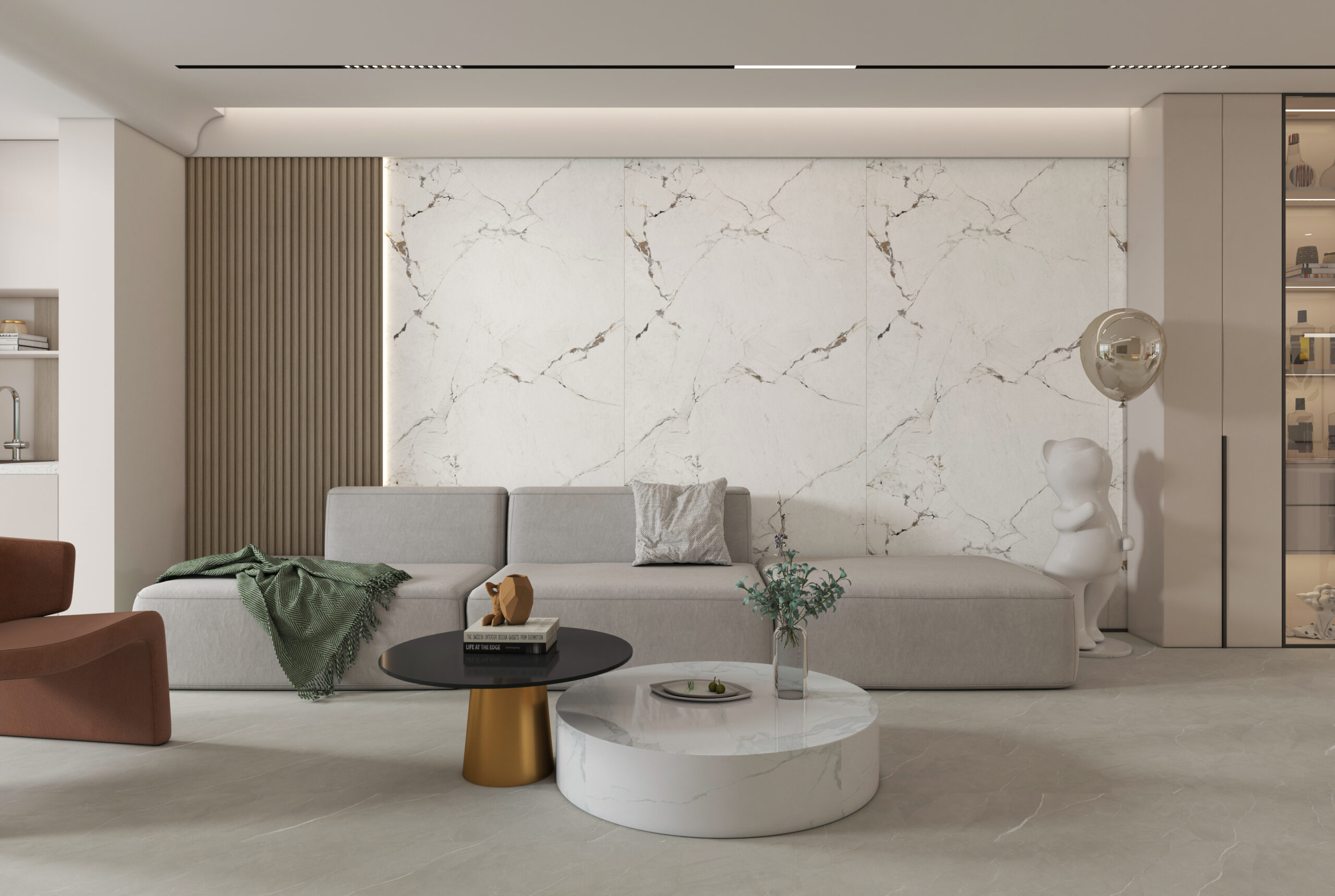
Ecoflors SPC wall panels are non-structural interior wall linings with a rigid stone-plastic composite core, bonded to a sound, flat wall with adhesive. Panels come 2.5–5.0 mm thick, up to 1,250 mm wide and up to 2,900 mm long, so one panel can often run from floor to ceiling. They are made at our Jiaxing factory for distributors, contractors and project buyers. Fire documents and trims are confirmed for the SKU you are quoting.
- 2.5–5.0 mm thickness
- Lengths 2,440–2,900 mm
- Datasheet per format
- Private label on request
- Thickness
- 2.5–5.0 mm
- Max. panel size
- 1,250 × 2,900 mm
- Wear layer
- 0.2 mm
- Made in Jiaxing, ChinaSPC wall panels are produced at our main factory in Jiaxing, alongside our SPC and LVT flooring lines.
- Sized for full-height wallsSix lengths from 2,440 to 2,900 mm and five widths from 950 to 1,250 mm.
- Documents per SKUFire and emissions reports are matched to the thickness, decor and market you are quoting.
- Your brand or oursPrivate-label cartons and labels, with conditions confirmed per order. Learn More About Ecoflors
Datasheet values
SPC Wall Panel Specification
Design values from the SPC wall panel datasheet. They are not third-party test results, and they are not the values of our SPC flooring: the two products have separate datasheets. The datasheet for the exact format and decor comes with the quotation.
| Property | Value | Method / note |
|---|---|---|
| Total thickness | 2.5–5.0 mm | Chosen per project; confirm the thickness on the quotation |
| Wear layer | 0.2 mm | Clear layer over the printed decor |
| Core density | 1.95–2.05 g/cm³ | Rigid SPC core |
| Dimensional stability | ≤0.10 % | ISO 23999 method |
| Curling | ≤2 mm | Per datasheet |
| Peel strength | ≥50 N/50 mm | Bond between decor layers and core, per datasheet |
| Mass per m² (calculated) | About 5 kg/m² at 2.5 mm; about 10 kg/m² at 5.0 mm | Thickness × core density. Not a measured weight; the datasheet gives the weight per panel |
| Dimension | Available sizes (mm) | What it means on site |
|---|---|---|
| Width | 950 · 1,220 · 1,230 · 1,240 · 1,250 | Fewer vertical joints across a wall; set out joints to suit the wall length and openings |
| Length (fixed vertically) | 2,440 · 2,500 · 2,600 · 2,700 · 2,800 · 2,900 | One panel floor to ceiling where the clear height, less the perimeter gaps, fits the panel length |
Construction
Inside an SPC Wall Panel
The panel uses the same layered principle as rigid SPC flooring, without a click profile or attached underlay: it is bonded flat to the wall. Its 0.2 mm wear layer is thinner than on flooring because a wall is not walked on. It takes knocks, scuffs and cleaning rather than foot traffic.

Surface coating
Coat over the wear layer. Finish and gloss per decor.
Wear layer, 0.2 mm
Clear layer protecting the print.
Printed decor film
Stone, marble, wood or plain looks.
SPC rigid core
1.95–2.05 g/cm³ stone-plastic composite.
Walls in heavy-impact zones, such as trolley routes in hospitals or hotel back-of-house corridors, are usually protected with corner guards or crash rails whatever the lining. If your project needs a different wear layer, ask at enquiry and we confirm what can be produced.
The decision on this page
SPC Wall Panels Against Tile, ACP and Wood Veneer
What changes on site and in the specification when a large-format SPC panel replaces the lining a wall would otherwise get. A general comparison, not test data: each product’s values come from its own datasheet and reports.
| What you are comparing | SPC wall panel | Ceramic tile | ACP (aluminium composite) | Wood veneer panel |
|---|---|---|---|---|
| Fixing | Adhesive to a sound, flat wall | Adhesive or mortar bed, then grout | Usually a sub-frame or rails | Adhesive or battens |
| Mortar and grout on site | None. The adhesive still needs its curing time | Yes | No | No |
| Joints on a 2.8 m wall | Vertical joints only, if one panel length covers the height | Grid of grout joints | Per panel size | Per panel size |
| Over existing tile | Possible if the tile is sound, flat and the adhesive maker approves the substrate | Usually removed or overlaid with a new bed | Framing takes up the old surface | Usually needs preparation |
| Moisture | Core is not wood-based. Wet areas still need a waterproofing layer behind the lining | Tile body resists water; grout and bed need sealing and a membrane in wet areas | Face does not absorb water | Wood-based; not for wet areas |
| Impact | Can dent under a hard, sharp knock; corner protection advised on trolley routes | Can chip or crack | Can dent | Can scratch or dent |
Fire documentation
Fire Performance for Interior Wall Linings
Wall linings are classified under different tests from floors. A floor class such as Bfl-s1 (EN 13501-1) or an ASTM E648 radiant panel result does not apply to a wall, even for a similar SPC material. The table shows what each market usually asks for. Your fire engineer or building control sets the class required for each room and route.
What Each Market Asks For
| Market | Classification for wall linings | Test behind it |
|---|---|---|
| EU / EEA | EN 13501-1 class for walls, written without “fl”, for example B-s1,d0 or C-s2,d0 | EN 13823 (single burning item) and EN ISO 11925-2 (small-flame ignitability) |
| UK | EN 13501-1 wall class, required by room type and circulation space under the building regulations (Approved Document B in England) | As EU |
| United States | Interior wall finish Class A, B or C under the building code (IBC Chapter 8). Class A: flame spread index 0–25; smoke-developed index 450 or less | ASTM E84 tunnel test, or NFPA 286 room-corner test where the code allows |
| Australia | Group number 1–4 for wall and ceiling linings under the NCC | AS 5637.1 (room-corner method) |
What We Supply
We do not print a fire class for SPC wall panels as a range-wide rating. A classification covers the tested panel: its thickness, decor, and how it was mounted and bonded in the test. Tell us the market and class your project names, and we reply with the report we hold for that build, or tell you plainly that we don’t hold one.
These panels are for interior walls. Exterior wall assembly tests, such as NFPA 285 in the US, cover exterior walls and are outside the scope of this product.
Installation Points to Settle Before You Order
-
Substrate and adhesiveEvery project
What to check
The wall must be sound, flat, clean and dry. Flatness tolerance, primer and the adhesive type follow the installation instruction and the adhesive maker’s data for that substrate. Old tile needs to be well bonded and degreased before bonding over it.
-
Perimeter and movement gapsPer format
What to check
A long vertical panel still moves with temperature. Leave the gaps given in the installation instruction for the panel length, and carry any building movement joint through the lining. Check the clear wall height against the panel length after those gaps.
-
Showers and wet roomsLocal code
What to check
The panel is a wall finish, not a waterproofing membrane. In wet areas, waterproof the wall to your local code first, then seal panel joints, corners and penetrations with the sealant and trims specified for the system.
-
Trims and accessoriesPer quotation
What to check
Ask for the trim schedule with the quotation. We confirm which profiles are available for your thickness and decor, and their lengths and finishes.
Supply and ordering
Ordering & OEM
Terms we can state before we’ve seen your specification. The rest is confirmed in the quotation.
Ordering Information
- Minimum order
- 800 m² per existing design or colour
- Custom decor
- From 2,200 m² per decor
- Production lead time
- Generally 35–40 days, reconfirmed when the order is placed
- Quotation basis
- FOB Shanghai is the default quotation basis. Other ports can be coordinated when required.
- Samples
- Sample kits on request. See sample requests.
- Customs classification
- Confirmed by the importer or customs broker for the destination
- Container loading
- Calculated per format in the quotation
- Payment terms
- Confirmed in the quotation
OEM & Private Label
SPC wall panels can ship under your brand, with cartons and labels printed to your artwork. Test reports stay in the name of the holder that obtained them; if your market needs documents in your own company name, tell us at enquiry. The OEM and private-label programme covers artwork, approvals and the first-order sequence.
Buyer questions
SPC Wall Panel FAQs
What sizes do Ecoflors SPC wall panels come in?
Widths of 950, 1,220, 1,230, 1,240 and 1,250 mm, lengths of 2,440, 2,500, 2,600, 2,700, 2,800 and 2,900 mm, and thicknesses from 2.5 to 5.0 mm. Where the clear wall height, less the perimeter gaps, fits the panel length, one panel runs floor to ceiling with no horizontal joint.
Why is the wear layer 0.2 mm when SPC flooring uses more?
A wall is not walked on. It takes scuffs, knocks and cleaning, so the wall panel is specified with a 0.2 mm wear layer, while flooring wear layers are sized for foot traffic. On trolley routes and other high-impact walls, plan corner guards or crash rails as you would for any lining.
What fire classification do the panels have?
A wall fire class belongs to the tested panel, thickness, decor and mounting, so we match the report to the SKU you are quoting rather than printing one range-wide class. Walls use their own classes: in Europe an EN 13501-1 class without “fl”, in the US ASTM E84 Class A, B or C, in Australia a Group number. A floor class such as Bfl-s1 does not apply to walls. Tell us the class your project needs.
Can SPC wall panels be installed over existing tile?
Yes, where the tile is sound, well bonded, flat and clean, and the adhesive maker approves it as a substrate. There is no mortar or grout, but the adhesive still needs its stated curing time. Flatness tolerance and primer follow the installation instruction.
How much expansion gap do large panels need?
Gaps at floor, ceiling, corners and openings follow the installation instruction for the panel length and substrate, and building movement joints are carried through the lining. The datasheet gives dimensional stability of ≤0.10 % (ISO 23999 method), but gaps are still required.
Can the panels be used in showers?
The SPC core is not wood-based and does not swell like wood panels, but the panel is not a waterproofing membrane. In showers and wet rooms, waterproof the wall to your local code first, then seal all joints, corners and penetrations with the specified sealant and trims.
What is the minimum order, and are matching trims available?
800 m² per existing design or colour, and from 2,200 m² for a custom decor. Production lead time is generally 35–40 days and is reconfirmed when the order is placed. Ask for the trim schedule with your quotation; we confirm which corner, edge and joining profiles are available for your thickness and decor.
Quotation
Send Your Project Requirements
Name, company, country, email and an estimated area are enough to start. Add any of these and the reply comes back matched to your walls:
- Panel thickness, width and length, if already fixed
- Decor codes or the look you need
- Substrate: existing tile, plasterboard, cement board or masonry
- Wet areas, and the fire class your project names
- Trims needed, total area, destination port and target delivery month
Prefer to write directly? Email sales@ecoflors.com or message us on WhatsApp +86 134 8633 9267. Other routes are on the contact page.
Request a Sample Kit
Wall panel samples in the decors and thicknesses you’re considering, before you fix a colour list.
Request Sample KitRequest Quotation & Trim Schedule
Answered by our sales team, not an automated quote.