Loose Lay LVT · No Adhesive · No Click · Factory Direct since 2017
Loose Lay LVT Flooring Manufacturer
Loose Lay LVT is a vinyl floor covering that holds position through self-weight and a specialised friction backing — without adhesive or a mechanical click system. Individual planks lift and replace in under 60 seconds without tools, making it the preferred specification for phased commercial renovation, raised access floors, and office environments where subfloor access is a recurring operational requirement.
Ecoflors supplies Loose Lay LVT factory-direct from Changzhou since 2017 — 4mm, 4.5mm, and 5mm with fibreglass reinforcement layer (single standard / dual-layer upgrade). CE EN 14041, Bfl-s1 EN 13501-1, FloorScore SCS-FS-05154, and GREENGUARD Gold 135463-420 per shipment. Loose Lay FOB from US$8.80/m². MOQ 800 sqm per SKU.
CE · EN 14041FloorScore · SCS-FS-05154GREENGUARD Gold · 135463-420Bfl-s1 · EN 13501-1ISO 9001:2015CARB 2
Three installation systems — choose by project requirement
Loose LayFriction only · 60s lift
Click LockMechanical · floating
DrybackFull adhesive · Class 44
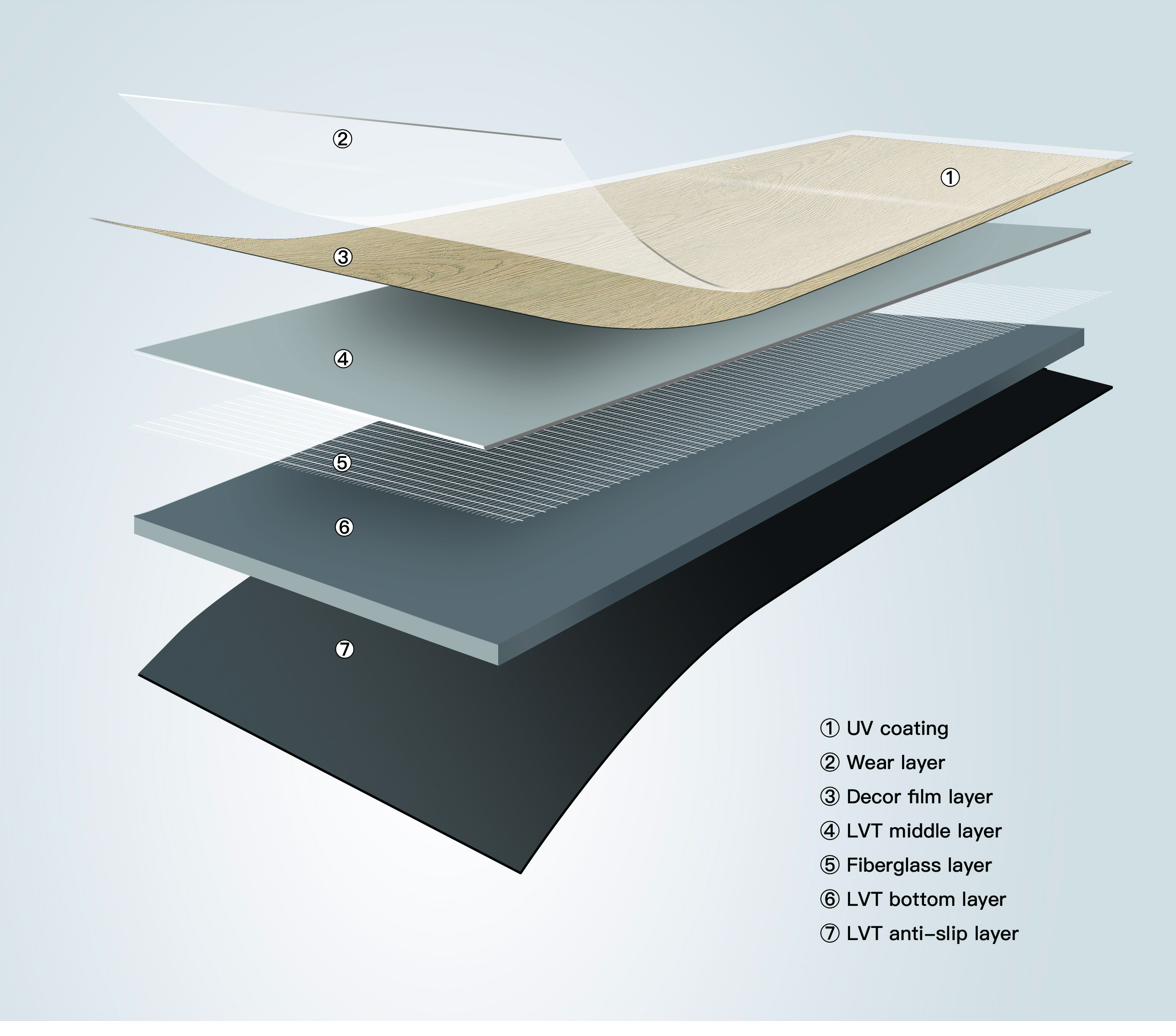
7-layer construction · Fibreglass reinforcement layer ⑤ · Single or dual-layer configuration
Construction profile · Loose Lay LVT
Why Loose Lay Holds Without Adhesive.
①
UV Coating
UV-cured topcoat — scratch, stain, and chemical disinfectant resistant. EN 16094 MSR-B2 rated. Protects the wear layer surface in daily commercial use.
0.01–0.02mm
②
Wear Layer
Transparent PVC film — the sole determinant of floor durability class. 0.5mm reaches EN 685 Class 33/42; 0.7mm reaches Class 43 heavy commercial.
0.5 / 0.7mm
③
Décor Film · EIR
High-resolution print registered to embossing die within ±0.1mm. Wood, stone, terrazzo, and carpet texture options. The visual and tactile surface buyers specify.
0.07mm
④
PVC Middle Layer
Flexible virgin PVC compound — provides the primary mass of the plank. Core density 1.95–2.05 g/cm³ per ISO 1183. Heavier planks resist migration better than lighter ones.
1.5–2.5mm
⑤
Fibreglass Reinforcement Layer
The critical stability layer — and the defining difference between Loose Lay and standard LVT. Prevents the PVC mass from stretching or curling under temperature change. Without fibreglass, a Loose Lay plank would migrate out of position within months. Available single-layer (standard) or dual-layer (raised access floor upgrade).
Single / Dual
⑥
PVC Bottom Layer
Secondary flexible PVC — balances the plank and distributes point load evenly across the friction backing below.
0.5–1.0mm
⑦
Anti-Slip Friction Backing
Textured PVC backing creates sufficient grip against concrete, screed, and existing tile to prevent plank migration under sustained foot traffic — without any adhesive compound.
0.3–0.5mm
Standard
Single Fibreglass Layer
Suitable for commercial office, retail, residential, and healthcare. Dimensional stability ≤0.10% across −20°C to +60°C. Standard specification for EU, Canada, and Australia.
Upgrade
Dual Fibreglass Layer
Higher anti-flex rigidity for raised access floors spanning between pedestals. Recommended for data centres, trading floors, and EU office buildings with underfloor cable management.
Installation system comparison · Choose by project type
When to Specify Loose Lay vs the Alternatives.
Project Requirement
Loose Lay LVT
Dryback / Click
Subfloor access needed post-install
✓ Lifts in 60 seconds, no tools
✗ Adhesive bond or click perimeter — repeated access damages both
Raised access floor (Doppelboden)
✓ Standard — dual fibreglass upgrade for heavy loads
✗ Click joints stress under panel flex; adhesive bond fails on removable panels
Phased renovation in a live environment
✓ Zone-by-zone — immediate re-entry, no cure time
✗ Dryback: 24–48h adhesive cure; Click: perimeter disruption per zone
UFH underfloor heating compatible
✓ Fibreglass layer stabilises across thermal cycling
✓ All three systems compatible at ≤27°C surface temperature
EN 685 Class 44 heavy industrial
✗ Not achievable — friction backing cannot replace full adhesive bond
✓ Dryback only — full-spread adhesive is mandatory for Class 44
Specification guidance: Loose Lay is the correct system when subfloor access, phased installation, or raised access floor compatibility is required. It is not suitable for EN 685 Class 44 heavy industrial environments — specify Dryback LVT for airports, supermarkets, and hospitals where wheeled load resistance is the primary requirement. For permanent residential installation without access requirements, Click SPC offers a lower FOB cost from US$6.18/m².
Technical parameters · Every figure third-party certified per shipment
Performance Data. Not Marketing Claims.
Every parameter below links to a third-party test certificate issued per production batch. Dimensional stability is the most critical figure for Loose Lay specifically — a plank expanding beyond ≤0.10% will migrate out of position under temperature cycling, even with friction backing in place.
Six certified parameters · Each explained in the context of Loose Lay-specific performance risks
≤0.10%
Dimensional Stability
The most critical Loose Lay parameter. A plank expanding beyond ≤0.10% over a 1.2m length generates 1.2mm of linear displacement — enough to overcome friction backing grip and cause visible plank migration at room perimeters.
EN ISO 23999 · ASTM F2199
Risk without fibreglass: solar gain in south-facing rooms can push substandard planks 3–5mm out of alignment within 12 months.
1.95–2.05 g/cm³
Core Density
Virgin PVC compound density — the determinant of plank self-weight. Heavier planks resist migration better; lighter low-cost planks (under 1.85 g/cm³) shift under foot traffic even with fibreglass reinforcement. Verified by hydrostatic balance per ISO 1183.
ISO 1183 · Hydrostatic method
Risk: low-density imports cut cost by 8–12% but fail field stability tests within 18 months of installation.
≥50N
Peel Resistance
Wear layer bond strength per 50mm width. In Loose Lay, horizontal shear at the wear layer is higher than in bonded systems because the plank can flex slightly under concentrated load. ≥50N ensures the bond exceeds any realistic shear force in commercial use.
ISO 24345 · per 50mm width
Risk: wear layer delamination at castor chair contact points — common in corporate offices. Fibreglass rigidity reduces flex, protecting the bond.
≤0.05mm
Residual Indentation
Permanent deformation after concentrated static load. In Loose Lay, a stationary load (server rack, office furniture) concentrates stress on a plank without adhesive support. ≤0.05mm average ensures recovery below the visible threshold after load removal.
ISO 24343-1 · Average of 3 tests
Risk: permanent visible dents under furniture legs — prevented by virgin PVC core density and UV-cured topcoat hardness.
Bfl-s1
Fire Classification
EN 13501-1 floor covering classification — mandatory for EU and UK commercial and public buildings. GREENGUARD Gold 135463-420 certificate supplied per shipment, accepted for LEED v4 EQ Credit and BREEAM Mat 03.
EN 13501-1 · EN 13823 · EN ISO 11925-2
25,000
Castor Chair Cycles
ISO 4918 castor chair test — no delamination, no surface failure at 25,000 cycles. Loose Lay must pass this without adhesive support. The fibreglass layer is essential rather than optional here — it prevents the micro-flex that would otherwise cause wear layer delamination at repeated castor contact points.
ISO 4918 · 5-wheel castor · No failure
Three thicknesses · Choose by application, EN 685 class, and fibreglass configuration
Thickness 01 · Entry level
4mm
Residential · Light commercial · Hotel guest rooms
Wear layer options0.5mm standard
EN 685 classClass 23 / 33
FibreglassSingle layer standard
Dim. stability≤0.10% · EN ISO 23999
Best applicationApartments · boutique hotels · low-traffic office
Price positioning: Loose Lay LVT carries fibreglass reinforcement + heavy backing, which prices it above standard rigid-core SPC. For project budgets below US$8/m², see our 6mm SPC click flooring from US$6.18/m² or 7mm SPC commercial range. Loose Lay is specified where access, phasing, or raised floors justify the premium.
Primary export markets · 60+ countries · Compliance per destination
Standard for Dutch corporate office renovation with raised cable floors (verhoogde vloer). CE DoP · Bfl-s1 Bouwbesluit · EN 685 Class 42. Rotterdam 22–26 days.
Multi-residential condos and BTR. Fibreglass handles −30°C to +35°C temperature extremes across Canadian climate zones. FloorScore · CARB 2. Vancouver 18–22 days.
High-rise residential and commercial office. NCC / BCA compliant. AS 4586 R10+ slip resistance. No adhesive means zero VOC off-gassing during installation. Melbourne 18–22 days.
All Loose Lay LVT shipments include CE DoP, Bfl-s1 EN 13501-1 fire certificate, FloorScore SCS-FS-05154, and GREENGUARD Gold 135463-420 as standard. Moreover, market-specific documents — UKCA for the UK, Eurofins IAC Gold for Germany, AS 4586 for Australia — are available at no additional charge for all destinations.
FOB transit times · Ningbo → key ports
Shipping from China to Your Warehouse.
🇳🇱 Rotterdam22–26 days
🇩🇪 Hamburg24–28 days
🇬🇧 Felixstowe26–30 days
🇨🇦 Vancouver18–22 days
🇨🇦 Toronto (via Halifax)24–30 days
🇦🇺 Melbourne18–22 days
🇦🇪 Dubai Jebel Ali18–22 days
Container loading: Loose Lay LVT at 5mm weighs approximately 8.5 kg/m². A 20ft container holds around 2,400 m² within the 28-tonne EU port weight limit. Recommend 20ft for all Rotterdam and Hamburg deliveries to avoid axle compliance issues at port gates.
Common questions from architects, specifiers, and distribution buyers evaluating Loose Lay against Click and Dryback alternatives.
What’s the structural difference between Loose Lay and Click LVT?
Click LVT relies on a mechanical locking edge — the failure point under thermal expansion or heavy rolling load is the click profile itself. Loose Lay has no locking edge; fibreglass reinforcement + friction backing hold the plank flat by weight and grip. For commercial use over 1,000 m² with subfloor access requirements, Loose Lay installs faster and repairs cheaper. For permanent residential without access requirements, 6mm SPC click flooring from US$6.18/m² is the cost-effective choice.
Does Loose Lay LVT really hold position without any adhesive?
Yes, in the conditions it’s designed for. The combination of plank self-weight (PVC core 1.95–2.05 g/cm³), fibreglass dimensional stability (≤0.10% per EN ISO 23999), and textured friction backing creates sufficient resistance against migration in standard commercial and residential applications. For perimeter doorways and high-traffic transitions in installations above 500 m², perimeter tackifier (releasable adhesive at edges only) is recommended. Full-spread adhesive is reserved for EN 685 Class 44 heavy industrial applications.
What MOQ and lead time should I plan for a project?
MOQ is 800 sqm per SKU. Production lead time is 20–28 days from deposit confirmation. A 20ft container holds approximately 2,400 m² of 5mm Loose Lay within the 28-tonne EU port axle weight limit. For distributor stocking programmes with mixed SKUs, consolidated production runs ship 28–32 days. Sample kit dispatches within 5 business days worldwide on request.
Is Loose Lay compatible with underfloor heating (UFH)?
Yes, up to 27°C surface temperature. Dimensional stability of ≤0.10% per EN ISO 23999 is maintained across thermal cycling. For UFH installations, the fibreglass reinforcement layer is the critical specification — single-layer fibreglass is sufficient for residential UFH; dual-layer is specified for commercial UFH or installations combining UFH with raised access floors. See our Netherlands market UFH specifications for detailed thermal cycling data.
What certifications cover the Loose Lay LVT range for export?
Every shipment includes FloorScore SCS-FS-05154, GREENGUARD Gold certificate 135463-420, CE EN 14041 Declaration of Performance, Bfl-s1 fire classification per EN 13501-1, REACH compliance, and phthalate-free plasticizer certification. Market-specific documents available at no charge: UKCA (UK), AgBB / Eurofins IAC Gold (Germany), AS 4586 R10+ (Australia), CARB 2 (Canada and US). Full test reports release on signed NDA via sales contact.
Direct factory contact · Loose Lay LVT · FOB price in 24h
FOB Price in 24 Hours. Guaranteed.
Tell us your thickness, fibreglass configuration (single or dual layer), wear layer, texture, target market, and annual volume. You receive a complete FOB quotation, compliance checklist for your destination market, container loading plan, and sample dispatch confirmation within one business day.
Since 2017≤0.10% Dim. StabilityFibreglass Single / DualBfl-s1 · EN 13501-1GREENGUARD Gold 135463-420FloorScore SCS-FS-05154MOQ 800 sqm / SKU
Rotterdam 22–26d · Vancouver 18–22d · Melbourne 18–22d
Loose Lay LVT inquiry · FOB price in 24h
Get Your Loose Lay FOB Quotation
Our export team responds within one business day — FOB pricing, fibreglass configuration options, market compliance checklist, container loading plan, and sample dispatch confirmation included.
Or email sales@ecoflors.com. Sample kit dispatched within 5 business days worldwide.
ISO 9001 · Since 2017
GREENGUARD Gold 135463-420
CE · FloorScore · Bfl-s1
24h Quote
Ecoflors Footer — Redesign Preview
Request physical samples & specs
1
Sourcing commercial-grade vinyl flooring? We structuralize resilient SPC & LVT with certified dimensional stability (EN ISO 23999 ≤ 0.10%) and advanced curling control (≤ 2mm). Contact our engineering sales desk for verified technical specifications and high-traffic project samples.