
Loose Lay LVT Flooring for Importers, Distributors & Project Buyers
Loose Lay LVT is a flexible vinyl plank with a fibreglass-reinforced LVT body and an anti-slip backing. It is laid edge to edge, with no click joint and no full-spread adhesive bed. We make it in three grades, 4.0, 4.5 and 5.0 mm total thickness: 14 standard SKUs, each with its own TDS.
- 3 grades · 14 standard SKUs
- 4.0 / 4.5 / 5.0 mm total thickness
- TDS download per SKU
- Fibreglass layer · anti-slip backing
- No click joint, no adhesive bed
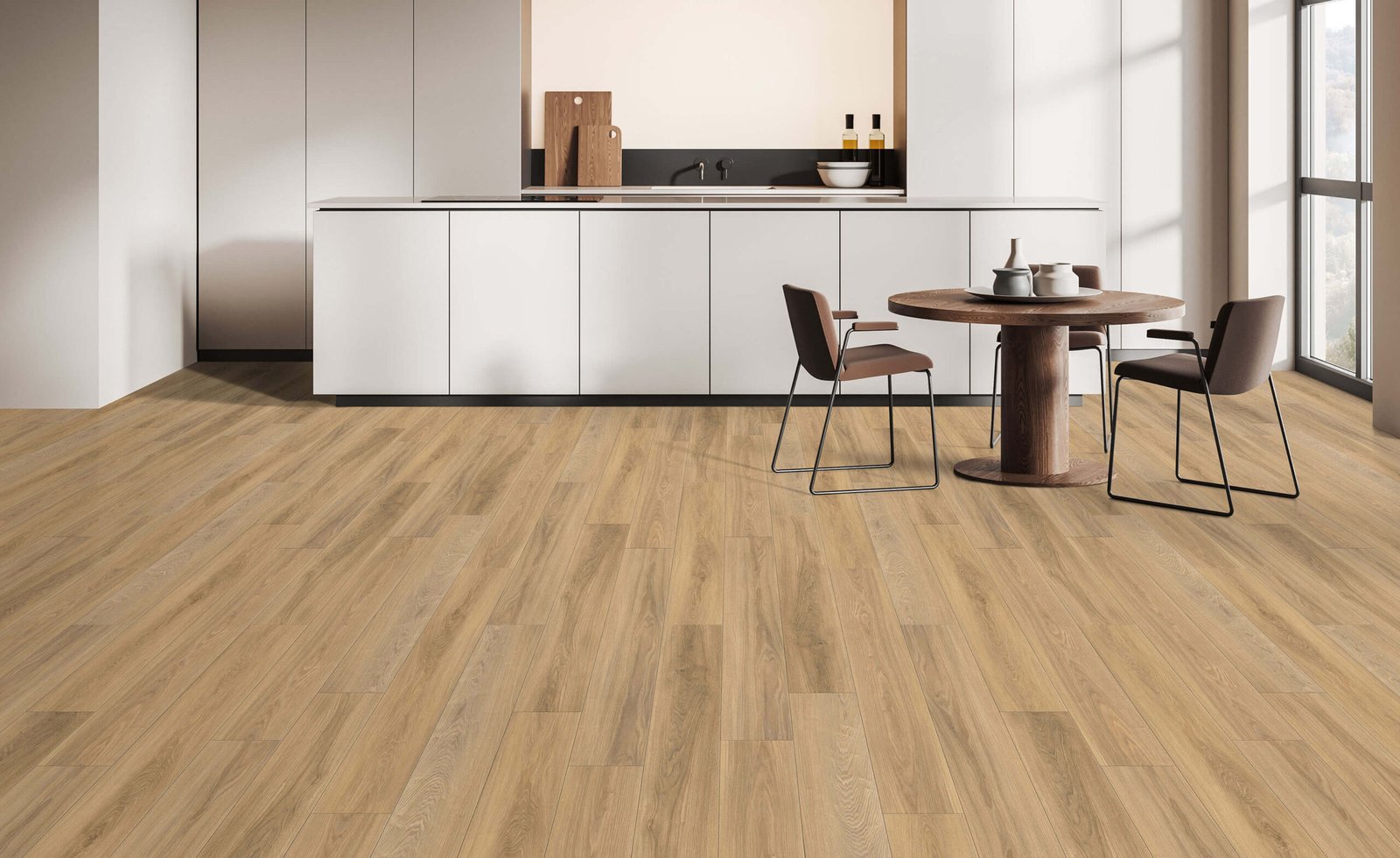
The anti-slip backing holds the floor, not a click joint or adhesive
Loose Lay LVT has no attached IXPE or EVA underlay. The 4.0, 4.5 and 5.0 mm figures cover the whole plank, from the UV coating down to the anti-slip layer, and the wear layer sits inside that figure. A 4.5 mm plank with a 0.50 mm wear layer is 4.5 mm in total.
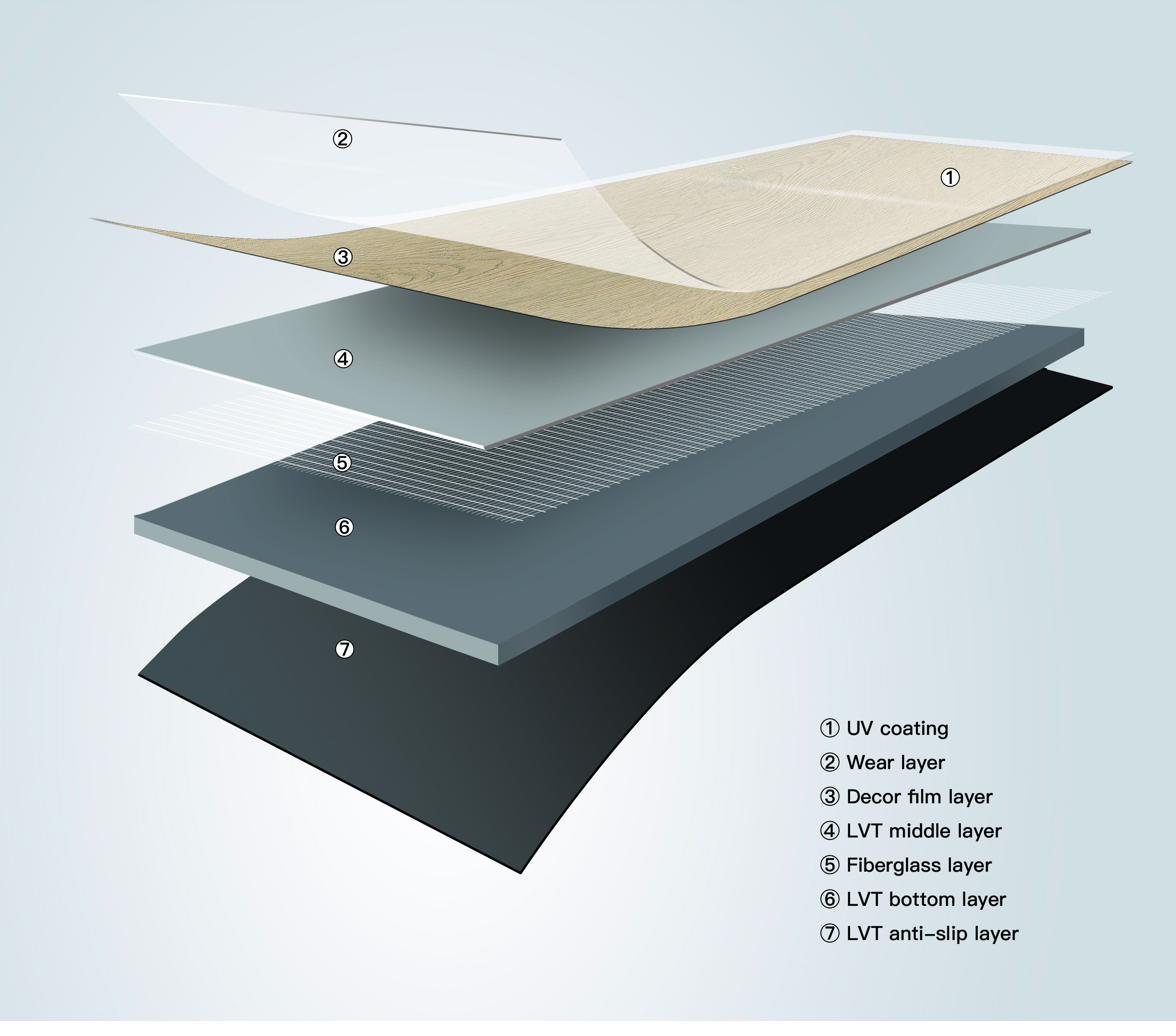
Confirm these six points before comparing price
Listed from the top of the plank to the underside. Each card links to the options further down this page.
UV coating
A matte surface treatment chosen with the décor and texture. A functional option, such as anti-stain or antibacterial, changes the cost and the reports that apply.
Wear layer
0.30 mm on 4.0 mm, 0.30 or 0.50 mm on 4.5 mm, 0.55 or 0.70 mm on 5.0 mm. It is part of the total thickness, not added to it.
Décor film and texture
The printed film carries the wood look; the texture follows the décor. Both decide whether the sample is approved.
Total thickness
The LVT middle and bottom layers make up most of the plank. Thickness changes floor height, board weight and how much floor fits in a container.
Fibreglass layer
A single fibreglass layer is standard on every grade. Premium 5.0 mm can be made with a double fibreglass layer on request.
Anti-slip backing
The backing sits directly on the prepared substrate. Room size, traffic, sunlight and doorways can still call for perimeter or grid fixing.
Three grades, 14 standard SKUs
Each grade is one total thickness. Choose the grade, then the wear layer and plank size, and download the TDS for that exact SKU before comparing quotations. The SKU code shows the grade and thickness, the wear layer and the plank size in millimetres.
Typical positioning only. A use class or project suitability depends on the tested build and the documents for the selected SKU, not on the grade name.
| SKU | Wear layer | Plank size | TDS |
|---|---|---|---|
| Essential 4.0 mm · 0.30 mm wear layer · not made in 1524 mm length | |||
| 0.30 mm (12 mil) | 184.15 × 1219.2 mm | TDS PDF | |
| 0.30 mm (12 mil) | 228.6 × 1219.2 mm | TDS PDF | |
| Select 4.5 mm · 0.30 / 0.50 mm wear layer | |||
| 0.30 mm (12 mil) | 184.15 × 1219.2 mm | TDS PDF | |
| 0.30 mm (12 mil) | 228.6 × 1219.2 mm | TDS PDF | |
| 0.30 mm (12 mil) | 228.6 × 1524 mm | TDS PDF | |
| 0.50 mm (20 mil) | 184.15 × 1219.2 mm | TDS PDF | |
| 0.50 mm (20 mil) | 228.6 × 1219.2 mm | TDS PDF | |
| 0.50 mm (20 mil) | 228.6 × 1524 mm | TDS PDF | |
| Premium 5.0 mm · 0.55 / 0.70 mm wear layer · double fibreglass on request | |||
| 0.55 mm (22 mil) | 184.15 × 1219.2 mm | TDS PDF | |
| 0.55 mm (22 mil) | 228.6 × 1219.2 mm | TDS PDF | |
| 0.55 mm (22 mil) | 228.6 × 1524 mm | TDS PDF | |
| 0.70 mm (28 mil) | 184.15 × 1219.2 mm | TDS PDF | |
| 0.70 mm (28 mil) | 228.6 × 1219.2 mm | TDS PDF | |
| 0.70 mm (28 mil) | 228.6 × 1524 mm | TDS PDF | |
Décor, surface texture, fibreglass configuration and packing are confirmed per order and quoted against the selected SKU. Tile formats are quoted on request. Carton, pallet and container loading data are calculated per SKU in the quotation.
Construction options before quotation
These options are not separate SKUs. They are confirmed per order and change the build, the packing data or the quotation basis.
Fibreglass layer
Single layer as standard on all grades. Premium 5.0 mm can be made with a double fibreglass layer; the quotation shows which one is priced, because weight and container loading change with it.
Anti-slip backing
Standard on every SKU. No IXPE or EVA underlay is attached, so the backing sits directly on the prepared substrate.
Tile formats
The standard SKUs are planks. Tile sizes are quoted against the build on request, together with the stone, carpet or terrazzo décor.
Send a useful selection brief: SKU codes, décor codes, single or double fibreglass (5.0 mm), room size, traffic, destination, annual volume and any document requirement.
Choose the wear layer by channel and project use
The combinations below follow the 14 standard SKUs. Wear layer thickness alone does not establish a use class; where a class is declared, it is on the TDS of the exact SKU.
| Wear layer | Grades | Buyer note |
|---|---|---|
| 0.30 mm (12 mil) | Essential 4.0 mm, Select 4.5 mm | Check the exact plank size, décor and TDS before quoting. |
| 0.50 mm (20 mil) | Select 4.5 mm | Keep total thickness and wear layer on separate lines in the quotation. |
| 0.55 mm (22 mil) | Premium 5.0 mm | Match any project requirement to the selected SKU and its report. |
| 0.70 mm (28 mil) | Premium 5.0 mm | Do not infer a use class from wear layer thickness or installation method. |
Surface texture is chosen with the décor
The wood-look planks come with natural wood grain, crystal or embossed textures, and EIR (embossed in register) on selected décors. Stone, carpet and terrazzo looks for tile formats use Coral or Leather texture. Texture depth, gloss and the décors each texture is offered on are covered in the surface textures and gloss guide.
Four project checks before Loose Lay is approved
“No full-spread adhesive” does not remove the need for an installation plan. The flooring supplier, the installer and the access-floor or substrate supplier need compatible instructions. The flooring installation guide covers subfloor and jobsite planning.
Substrate
Confirm flatness, strength, cleanliness, surface condition and compatibility with the anti-slip backing.
Room and traffic
Share the room dimensions, entrances, rolling loads, direct sunlight and traffic pattern so the fixing plan can be reviewed.
Perimeter or grid fixing
Check whether the installation instruction calls for releasable fixing at edges, doorways, transitions or within the field.
Raised access floors
Confirm the panel system, joints, concentrated loads and access frequency. Loose Lay construction alone does not approve every raised-floor project.
Loose Lay, Click LVT or Dryback?
| Decision | Loose Lay LVT | Click LVT | Dryback LVT |
|---|---|---|---|
| How it stays down | Anti-slip backing; the project fixing plan may add perimeter or grid fixing. | Mechanical click joint, assembled as a floating floor. | Full-spread adhesive over a prepared subfloor. |
| Joint | No click joint; planks are laid edge to edge. | Profiled locking joint. | No click joint; planks are bonded to the substrate. |
| Access and replacement | A plank can be lifted where the fixing plan permits, useful when the project needs access below the floor. | Access depends on the room layout and the plank’s position in the installation. | A bonded plank is removed and the adhesive bed prepared again. |
| Subfloor focus | Flatness, stability, cleanliness, backing contact and fixing details. | Flatness, expansion planning and the locking-system instructions. | Smoothness, dryness, adhesive compatibility and curing conditions. |
Documents are matched by SKU, construction and market
Some values are fixed on the TDS of each SKU. Others depend on a test report for one named build, and those are matched to your SKU and market rather than published as range-wide ratings. Certificates we currently hold are on the certifications page.
| Item buyers check | Declared in | How you get it for your order |
|---|---|---|
| Thickness, wear layer, fibreglass configuration | TDS, per SKU | Download from the grades table above |
| Dimensional stability, curling, indentation | TDS, per SKU | Download from the grades table above |
| Castor chair, abrasion group | TDS, per SKU | Download from the grades table above |
| Utilisation class | TDS, where declared | Do not infer a class from thickness, wear layer or installation method |
| Reaction to fire, slip resistance, emissions | Test report on a named build | Matched to SKU and market in the quotation |
| HS code reference | Import preparation | The importer or broker confirms the final code |
If a specification names fire, slip, emissions, a utilisation class or another standard, send the standard and the proposed build. We check which report applies and tell you about any gap before the claim goes into a quotation or submittal.
Your brand programme, confirmed before production
Product, sample, label and sales material should describe the same construction, thickness, wear layer and document responsibility. See the OEM and private-label programme.
Approve the construction before artwork
Confirm the total thickness, wear layer, fibreglass configuration, décor and texture first. Carton artwork, marks, labels, barcode data, sample boards and installation information are then prepared around the approved SKU.
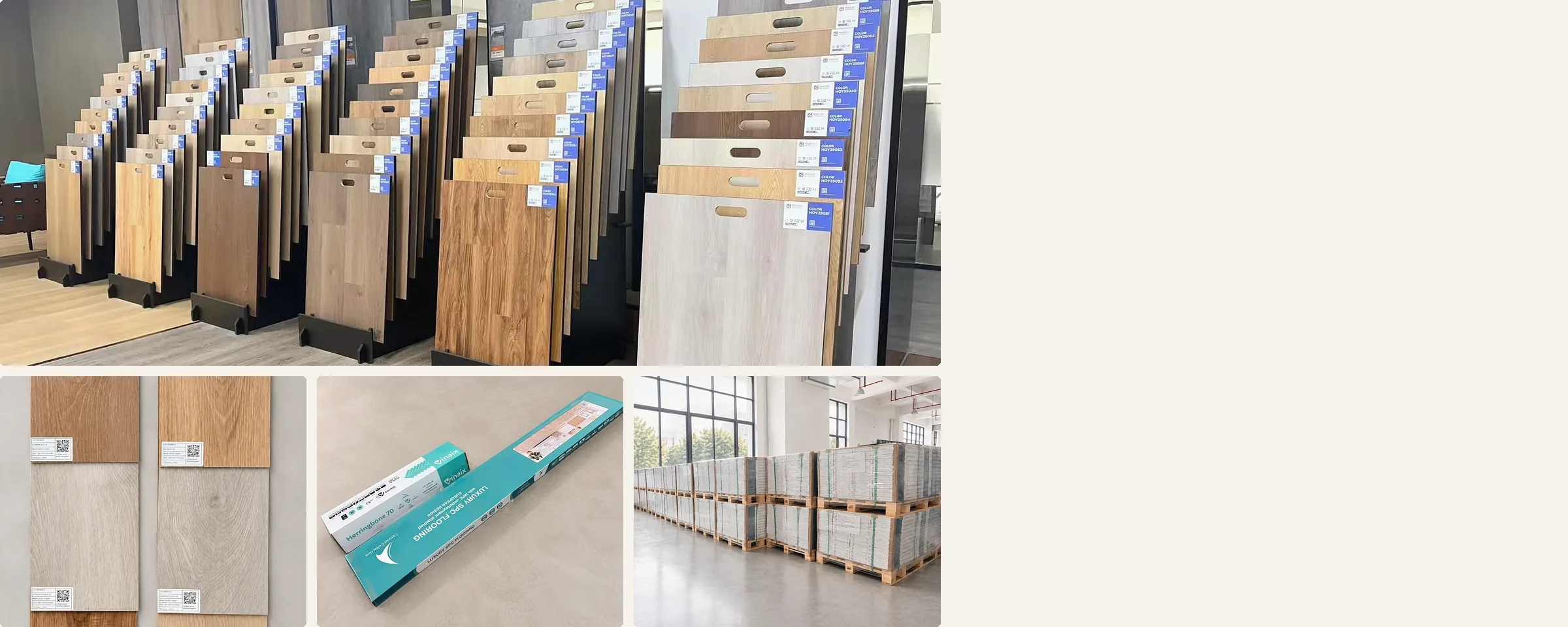
- Brand and collection name
- Carton artwork and marks
- Labels and barcode data
- Sample board brief
- Installation guide responsibility
- Pre-production approval
- Standard SKU, existing décor
- From 800 m² per design / colour
- Custom décor or OEM design
- From 2,200 m²
- Production
- Typically 35–40 days after order and specification confirmation
- Shipping terms
- FOB Shanghai
- Samples
- Standard samples free; normally 7–14 days; courier paid by the buyer and refunded against a later formal order
Final MOQ, timing and sample arrangement are confirmed in the quotation, because construction, colour split, packaging and approval work can change the plan.
Loose Lay LVT buying questions
What is Loose Lay LVT?
Flexible LVT without a click joint, laid on an anti-slip backing. The fibreglass-reinforced LVT body supports dimensional stability while the backing sits against the prepared substrate.
Does “loose lay” always mean zero adhesive?
No full-spread adhesive bed is used. Room size, traffic, sunlight, doorways and the substrate may still call for perimeter or grid fixing under the approved installation plan.
What changes between 4.0, 4.5 and 5.0 mm?
The wear layer options, floor height, board weight and the amount of floor per container. Essential 4.0 mm has a 0.30 mm wear layer, Select 4.5 mm 0.30 or 0.50 mm, and Premium 5.0 mm 0.55 or 0.70 mm, with a double fibreglass layer available on request.
Which utilisation class is declared?
Check the TDS of the exact SKU. A wear layer thickness does not create a class. Send the class your tender names, and we check which documented build can meet it.
Can I order 200 m²?
Not as a production order. The MOQ for a standard SKU in an existing décor starts at 800 m² per design / colour; custom décors start at 2,200 m². For evaluation, request samples first.
Can a single loose lay board be lifted and replaced?
Yes. With no click joint and no full-spread adhesive bed, a damaged board can be lifted and a new one laid in its place. Keep a few spare cartons from the same order for this.